Rescue operation in Kyushu
Japan searches collapsed mall after powerful Kumamoto earthquake
Workers remain unaccounted for after part of a shopping centre gave way, while damage to roads, railways and homes complicates the response.
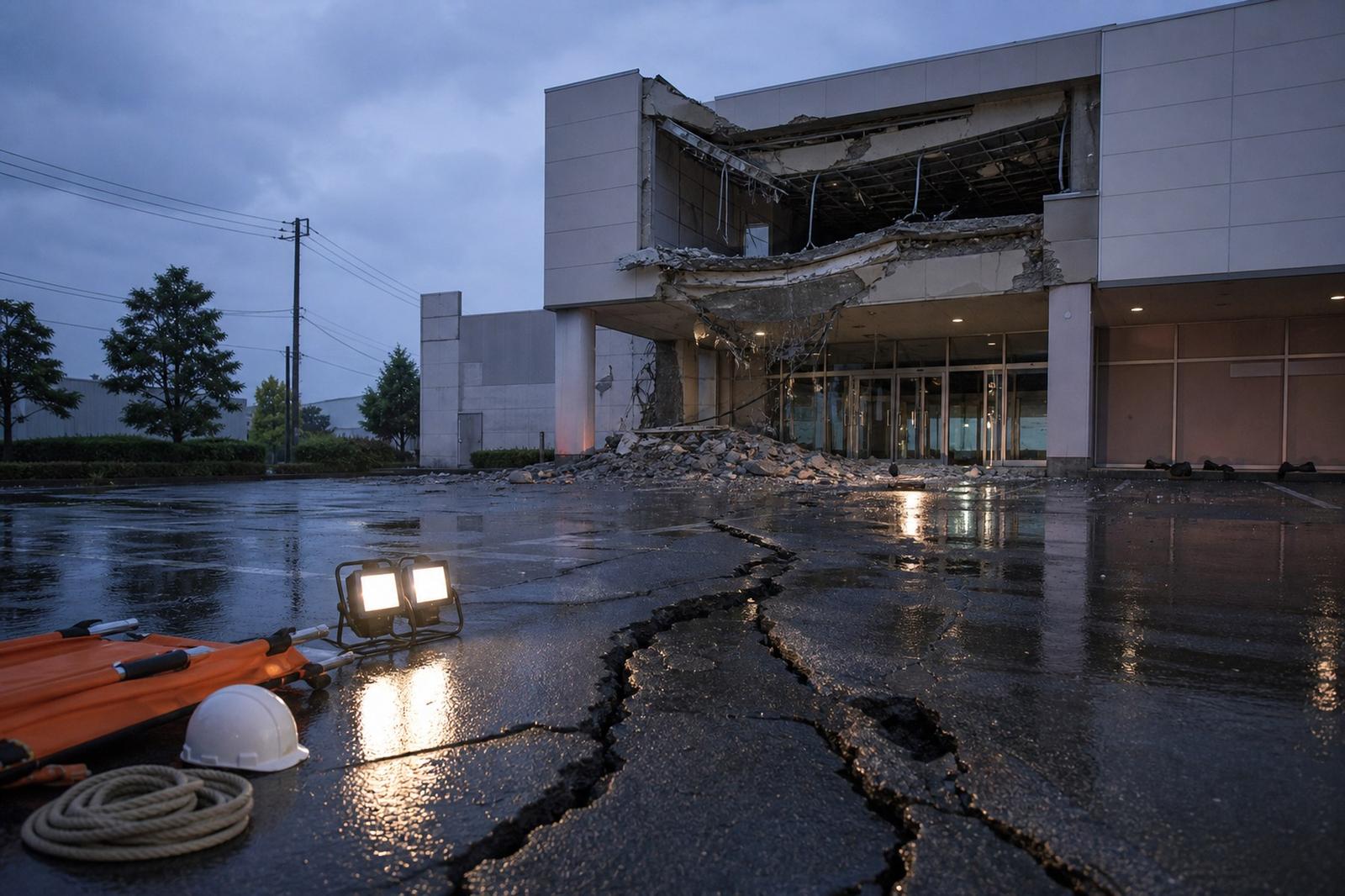
Rescue teams searched through the remains of a shopping centre in southwestern Japan on Tuesday night after a powerful earthquake struck Kumamoto Prefecture, damaging buildings, roads and transport links across part of Kyushu.
Part of the second floor of AEON MALL Kumamoto in Kashima collapsed after an explosion was reported during the evacuation of the building. Police information carried by Kyodo News indicated that about 20 to 30 employees remained unaccounted for. Several people had already been pulled from the debris and taken to hospital, but officials had not established a definitive casualty toll by publication time.
The earthquake occurred at 4.27pm local time. The Japan Meteorological Agency measured its magnitude at 7.1 and placed its focus about 10 kilometres underground. The agency recorded the maximum intensity of seven on Japan’s shindo scale in Uki and Hikawa, an indication of exceptionally violent local shaking rather than a second estimate of the earthquake’s magnitude. The US Geological Survey calculated a magnitude of 6.8; such differences are common because agencies use distinct data and calculation methods.
A search under unstable structures
The collapse at the shopping centre quickly became the most urgent rescue site. Around 200 customers and employees were reported to have reached an outdoor car park, while emergency crews worked around a building that may have suffered both structural and utility damage. The precise cause of the reported explosion had not been confirmed.
Hospitals in Yatsushiro and Kumamoto admitted roughly 90 injured people between them, according to Kyodo figures cited by the Associated Press. The severity of their injuries was not immediately clear. Elsewhere, fires were reported and emergency calls described collapsed homes, broken water pipes and damaged bridges.
Prime Minister Sanae Takaichi said the government had sent an assessment team and instructed ministries to coordinate with local authorities.
“Act in close coordination with local governments and, under the principle of prioritizing human life above all else, spare no effort in our emergency disaster responses, including saving lives and rescuing disaster victims, with the Government working as one.”
Police, fire-service and military helicopters were deployed to inspect areas that could not be reached or assessed quickly from the ground. The government warned people in the strongest-hit districts to remain in safe places because damaged buildings could fail during further tremors.
Power cuts and transport disruption
About 40,000 households lost electricity, while approximately 300,000 people received instructions to use evacuation centres, according to Japan’s disaster-management authorities as reported by El País. Water outages were also recorded, prompting the government to prepare targeted assistance for affected communities.
Kyushu Shinkansen services and local trains were suspended for safety inspections. A train derailed and fell onto its side at Yatsushiro station, though early reports did not establish whether anyone aboard was seriously hurt. The runway at Aso Kumamoto Airport was closed, and damaged sections of road and bridge infrastructure restricted movement through the affected zone.
Kumamoto Castle, one of the region’s best-known landmarks, suffered fresh damage to sections of its stone walls. The structure was extensively damaged by the 2016 earthquake sequence and had undergone years of painstaking reconstruction.
The initial tsunami advisory covered the Ariake and Yatsushiro seas and neighbouring coastal areas. It was lifted within two hours. Japan’s nuclear regulator reported no abnormalities at three nearby nuclear power stations, removing one of the most serious potential secondary risks from the immediate response.
A region confronting the memory of 2016
The earthquake struck a region acutely aware that the first major shock may not end the danger. In April 2016, Kumamoto experienced a destructive sequence in which an initial severe earthquake was followed by an even stronger shock little more than a day later. That experience has shaped official warnings and public behaviour.
Takaichi urged residents to remain alert for about a week because another earthquake of similar intensity could occur. Meteorological officials emphasised the particular danger from landslides, falling masonry and already weakened buildings. Heavy aftershocks can also disrupt rescue work by forcing teams to withdraw from unstable structures.
For the first night, the central questions remained unresolved: how many people were inside the collapsed section of the shopping centre, whether isolated communities had suffered unreported damage and how quickly electricity, water and transport could be restored. Japan’s extensive earthquake preparations give responders a tested system, but the violence of the shaking and the concentration of damage around Kumamoto have made this a large and still-developing emergency.
Frequently asked
- Where did the Kumamoto earthquake strike?
- The earthquake’s focus was in Kumamoto Prefecture on Kyushu, southwestern Japan, with the strongest shaking recorded in Uki and Hikawa.
- Why are two different magnitudes being reported?
- Japan’s meteorological agency estimated magnitude 7.1, while the US Geological Survey calculated 6.8 using different seismic data and methods.
- Is there still a tsunami threat?
- No immediate tsunami threat remained after the advisory for the Ariake and Yatsushiro seas was lifted within two hours.
Sources
Around World
A look at recent reporting on world from the Étude newsroom.
Related by topic
Other Étude stories tagged with the same topics as this article.
More in World

Kyiv Holds the Line, and the West's Economic Weapons Start to Bite

The Scarcest Thing in Tech Is Now a Computer

Trending at Étude
Critical minerals Washington Backs a Kazakh Tungsten Mine. The President's Sons Are Inside the Deal.
Luxembourg taxes Luxembourg's income-tax classes (1, 1a, 2) explained: who falls into each
Connectivity Mobile and internet providers in Luxembourg compared
Homeownership explained How to buy a property in Luxembourg: the process, costs and notary