Ukraine's air-defence gap
Russian missile barrage kills at least nine in Kyiv as Patriot stocks run low
Only one of 27 ballistic missiles was intercepted in an overnight assault that again turned Kyiv's shortage of defensive ammunition into a civilian emergency.
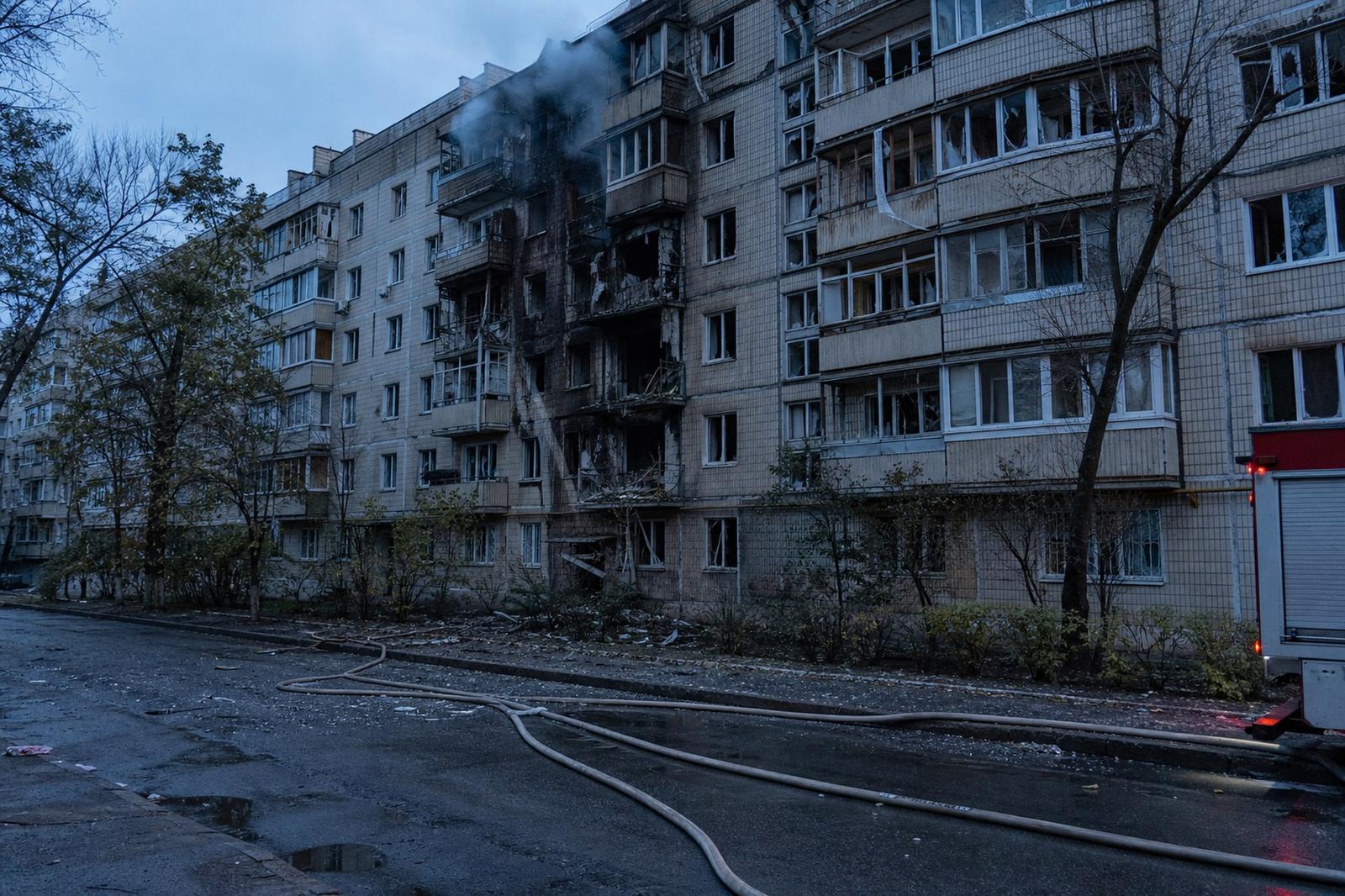
Russia struck Kyiv with ballistic missiles and drones overnight into Saturday, killing at least nine people and wounding 33, according to Ukrainian authorities. The barrage hit residential areas of the capital and opened a new round of searches through damaged buildings as emergency crews worked into the morning.
The attack was notable not only for the casualties but for how little of its most dangerous component Ukraine could stop. The Ukrainian Air Force said Russia launched 27 ballistic missiles and that only one was intercepted. It also reported neutralising 154 of 185 attack drones and decoys, a sharp contrast that illustrates the different levels of protection available against slower unmanned aircraft and fast ballistic weapons.
The toll remained provisional on Saturday. It came after another major Russian attack two days earlier killed at least 10 people and wounded more than 50 across Ukraine. The succession of barrages points to a sustained effort by Moscow to exploit shortages in the Western-supplied systems that protect major cities from ballistic missiles.
A shortage measured in lives
Ukraine has developed an extensive, layered defence against drones, using aircraft, electronic warfare, mobile teams and surface-to-air systems. Ballistic missiles pose a harder problem. Their speed and steep flight path leave defenders little time to detect, track and destroy them.
The US-designed Patriot system is central to Ukraine's ability to meet that threat, particularly through its more advanced interceptors. But the ammunition is scarce, expensive and difficult to manufacture quickly. Demand has risen outside Ukraine as the United States and its partners expend interceptors during the war with Iran, tightening a supply chain that was already unable to match Kyiv's needs.
The consequences are visible in the disparity between the interception figures. Ukraine can defeat a high proportion of drones during some attacks, yet a small number of ballistic missiles that penetrate the shield can demolish apartments, damage emergency infrastructure and force large parts of a city into shelter.
Washington retreats from a promise
At NATO's summit in Ankara on 8 July, US President Donald Trump said Washington would give Ukraine a licence to manufacture Patriot interceptors. Kyiv had sought such an arrangement to reduce its dependence on deliveries from limited American and allied inventories.
Three weeks later, Trump publicly cast doubt on that commitment during a Cabinet meeting at Camp David. His language transformed what had been presented as an agreement into an unresolved discussion.
“We have not agreed to that. We’re talking about it. But it’s a hard thing to give away that kind of technology,” Trump said.
Even an approved licence would not answer the immediate shortage. Producing sophisticated interceptors requires industrial capacity, specialised components, technical assistance and time. For Ukraine, domestic manufacture is a strategic project; missiles already in storage elsewhere are what determine whether the next incoming weapon can be stopped.
The policy reversal is therefore consequential in two ways. It introduces doubt over a long-term route to greater Ukrainian autonomy and signals uncertainty about the near-term American commitment at the moment when Russia is increasing pressure on Kyiv's defences.
Europe has started building an alternative
European governments have recognised that the shortage extends beyond Ukraine. On 13 July, Denmark, France, Germany, Italy, the Netherlands, Norway, Spain, Sweden and the United Kingdom joined Ukraine in announcing an Integrated Anti-Ballistic Missile Coalition.
The initiative is intended to combine industrial capacity, research and Ukraine's combat experience to build a shared defensive capability for the continent. It is strategically important, but it remains an early-stage answer to a present-tense emergency. European systems and production lines cannot immediately replace the interceptors Kyiv is using now.
That gap gives the latest attack significance beyond another grim entry in the war's daily toll. Russia's invasion has entered its fifth year, and Kyiv has become highly capable at producing drones and striking targets deep inside Russia, including oil facilities. Yet protection against ballistic missiles still depends heavily on technology and ammunition controlled by partners.
Saturday's devastation makes that dependence concrete. Diplomatic declarations and industrial plans operate on timelines of months or years. A ballistic missile crosses the final portion of its flight in minutes.
Frequently asked
- How many people were killed in the Kyiv attack?
- Ukrainian authorities reported at least nine deaths and 33 wounded civilians, with the toll still provisional on 1 August.
- Why could Ukraine stop so few ballistic missiles?
- Ukraine has a critical shortage of the advanced interceptors used by Patriot systems, which are central to its defence against ballistic weapons.
- Did the United States agree to let Ukraine manufacture Patriot missiles?
- Donald Trump announced such a licence on 8 July but said on 31 July that no agreement had been reached and that discussions were continuing.
- Can Europe's new missile coalition solve the shortage?
- The coalition may expand European capacity over time, but research, industrial integration and production cannot supply an immediate defence against current attacks.
Sources
Around World
A look at recent reporting on world from the Étude newsroom.
Related by topic
Other Étude stories tagged with the same topics as this article.
More in World


Trending at Étude
Luxembourg taxes Luxembourg's income-tax classes (1, 1a, 2) explained: who falls into each
Homeownership explained How to buy a property in Luxembourg: the process, costs and notary
Connectivity Mobile and internet providers in Luxembourg compared
Personal finance How the Luxembourg state pension works: retirement age, contributions and how it's calculated