Transatlantic realignment
Canada's Defence Chief Comes to Luxembourg, and Europe Is the Real Audience
The first visit by a Canadian federal minister in 81 years was a one-day affair in a tiny country — and a signal of how far Ottawa is drifting from Washington toward the EU's new defence machine.
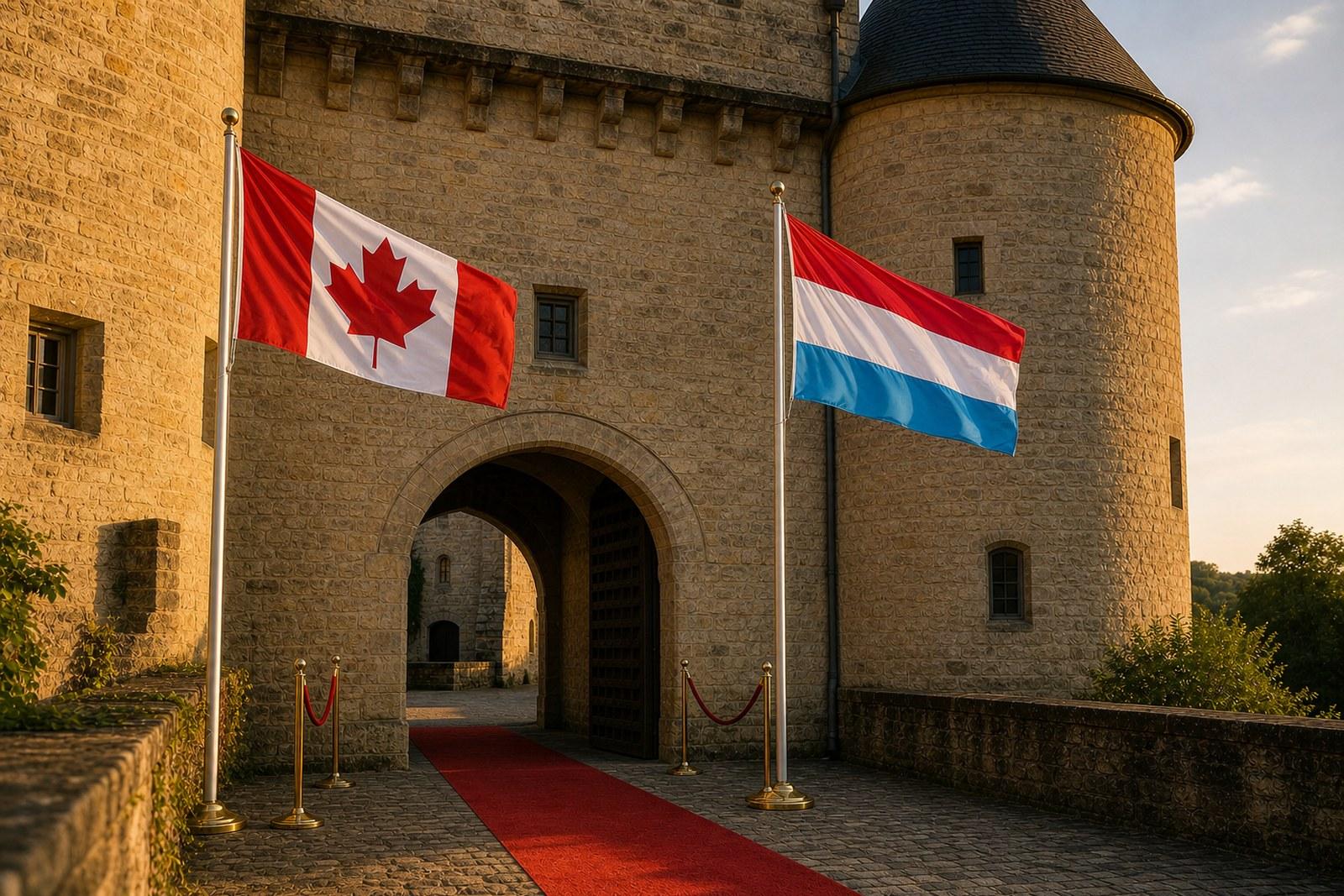
For 81 years, no member of Canada's federal government had set foot in Luxembourg on official business. That streak ended on Friday, when David McGuinty, Canada's minister of national defence, was received with military honours at Bourglinster Castle and spent the day discussing the war in Ukraine, an EU programme called SAFE, and a transatlantic relationship that no longer runs solely through Washington.
Canada and Luxembourg have exchanged diplomats since the final months of the Second World War, yet it took until June 2026 for a Canadian cabinet minister to make the trip. That the visitor was the defence minister — and that he came to a country whose entire armed forces would fit inside a single Canadian brigade — says less about Luxembourg's military heft than about where the Grand Duchy now sits in Europe's security architecture.
A handshake aimed at Europe
The tone was unmistakably warm. "It is a great honour to be here for Canada," McGuinty told reporters at a joint press conference with Yuriko Backes, Luxembourg's defence minister, held at the Hôtel Saint Augustin. Backes, for her part, offered "my deep gratitude for being such a fantastic ally, friend, and for being with us."
Ukraine ran through the conversation. "Both of our countries supported and are continuing to support" Kyiv, Backes said, casting the partnership less as ceremony than as a working alliance under strain. McGuinty, who also met representatives of the Chamber of Deputies, framed the day as part of a deliberate Canadian turn outward: "We are going to diversify, we are going to expand, we are going to branch out."
The phrase carried an unspoken subject. Under President Donald Trump, Ottawa's traditional reliance on the United States — for trade, for defence procurement, for strategic cover — has become a liability Canadian ministers no longer take for granted. Europe is the hedge, and Luxembourg, for reasons of geography and institution, is one of its doorways.
SAFE, and the 80 percent that mattered
The substance behind the symbolism is a financial instrument with a bureaucratic name: SAFE, or Security Action for Europe, a €150 billion EU borrowing facility created under the bloc's Readiness 2030 defence package to bankroll joint arms procurement. In February 2026, Canada became the first non-European country admitted to it — an agreement formally concluded by EU member states and ratified by the European Parliament.
For Ottawa, the prize was access on favourable terms. Canadian negotiators secured an exemption allowing up to 80 percent Canadian content on joint purchases, far above the 35 percent ceiling that normally applies to manufacturers from outside the bloc. In practice, that lets Canadian defence firms bid into European rearmament rather than watch it from across the ocean.
"Canada is one of the European Union's closest allies. Having Canada joining SAFE highlights the deep trust between us and sets a strong precedent for how the EU can collaborate with key strategic partners."
The words belong to Vasilis Palmas, Cyprus's defence minister, whose country held the rotating Council presidency when the deal closed. They double as a description of what Friday's visit was meant to consolidate.
Why the road runs through the Grand Duchy
Luxembourg is an improbable but logical host for this conversation. In absolute terms the country spends a fraction of what its larger neighbours do on defence, and has spent years living down a reputation as NATO's lightest contributor. Yet it is also home, in Capellen, to the NATO Support and Procurement Agency — the alliance's main purchasing arm — which makes the Grand Duchy a natural node in any discussion about who buys what, and from whom.
Backes has used her tenure to push Luxembourg's military spending sharply upward and to argue that a small state earns its seat through reliability rather than size. A visit by the Canadian defence minister, the first of its kind in eight decades, is the kind of validation that argument needs.
- The visit was the first by a member of Canada's federal government to Luxembourg in 81 years of diplomatic relations.
- Canada is the first non-EU country to join the €150 billion SAFE procurement programme.
- An exemption allows up to 80 percent Canadian content on joint purchases, against a 35 percent norm for third countries.
None of this rewrites the balance of power. Canada will not anchor European defence, and Luxembourg will not become a military heavyweight. But the optics of the day — a Canadian minister honoured at a Luxembourg castle, talking about buying weapons together rather than buying them from America — capture a recalibration that is real, and that a small, institution-rich country is unusually well placed to host.
Frequently asked
- Why was the visit described as historic?
- It was the first time in 81 years of Canada–Luxembourg diplomatic relations that a member of Canada's federal government visited the Grand Duchy.
- What is the SAFE programme?
- SAFE (Security Action for Europe) is a €150 billion EU borrowing instrument under the Readiness 2030 package that finances joint defence procurement; Canada became its first non-European member in February 2026.
- What does the 80 percent rule mean for Canada?
- Canada negotiated an exemption letting joint purchases contain up to 80 percent Canadian content, well above the 35 percent ceiling that usually applies to manufacturers from outside the EU.
Sources
Around Europe
A look at recent reporting on europe from the Étude newsroom.
Related by topic
Other Étude stories tagged with the same topics as this article.
More in Europe


Trending at Étude
Luxembourg taxes Luxembourg's income-tax classes (1, 1a, 2) explained: who falls into each
Homeownership explained How to buy a property in Luxembourg: the process, costs and notary
Connectivity Mobile and internet providers in Luxembourg compared
Personal finance How the Luxembourg state pension works: retirement age, contributions and how it's calculated