NATO Summit
NATO opens Ankara summit hours after deadly Russian strike on Kyiv
As 32 leaders gather at Erdoğan's presidential complex, a hesitant Donald Trump, a new five-percent spending goal and an overnight Russian barrage on Kyiv frame two tense days.
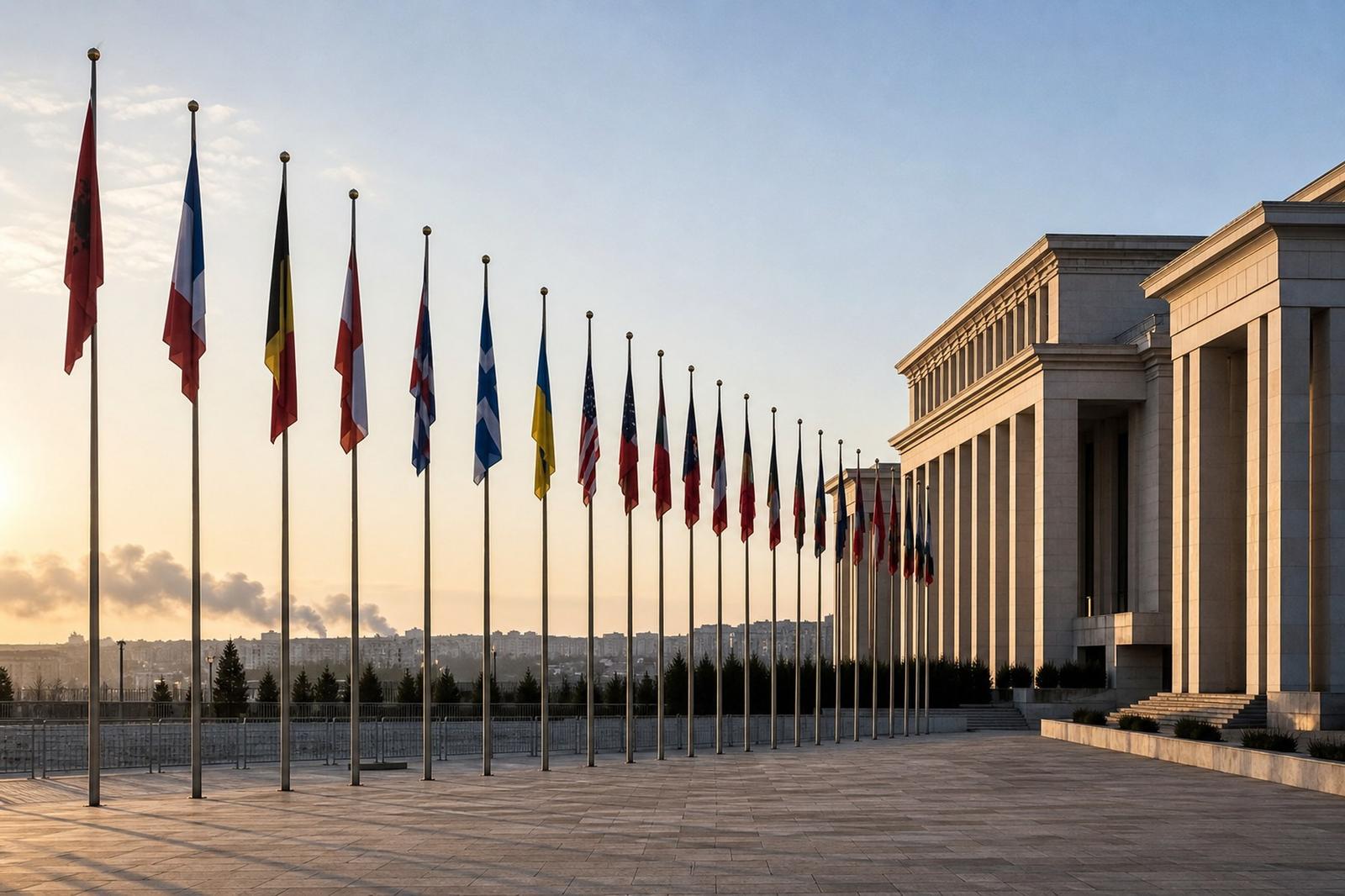
ANKARA — NATO's 32 leaders opened a two-day summit at Recep Tayyip Erdoğan's presidential complex on Tuesday, gathering under the twin pressures of an American president openly ambivalent about the alliance and a Russian war that reached deep into Kyiv only hours earlier.
The meeting, chaired by Secretary General Mark Rutte, is the first the alliance has held in Turkey in more than two decades, and it convenes at a moment of unusual strain. President Donald Trump, whose commitment to NATO's mutual-defence guarantee European capitals have spent months trying to shore up, travelled to Ankara having made little secret of his reluctance. "Except for the fact that it was being held in Turkey by President Erdoğan, I don't think I would have gone to it," he said before departing — a remark that captured both his warmth toward his host and his coolness toward the institution.
A summit framed by a strike
The diplomacy was overshadowed before it began. In the early hours of Monday, Russia launched what Ukrainian officials called one of the heaviest bombardments of the year against Kyiv, firing 68 missiles and 351 drones overnight, according to Ukraine's military. At least 16 people were killed in the capital and dozens wounded, with rescue crews pulling residents from collapsed apartment blocks. Mayor Vitali Klitschko said the Podilskyi district was hit hardest.
It was the second major assault on the capital in a week, and it underscored a grim arithmetic that will shadow the talks: nearly every ballistic missile Russia fired reached its target, a reflection of Ukraine's dwindling stock of Patriot interceptors. Trump and President Volodymyr Zelensky are expected to meet on the summit's sidelines.
The five-percent question
At the centre of the formal agenda sits money. A year after allies agreed to lift defence and security spending toward 5% of GDP by 2035 — 3.5% for core military needs and a further 1.5% for infrastructure, cyber-defence and industrial capacity — Rutte wants governments to arrive with concrete plans rather than aspirations. He has framed the summit around three priorities: raising investment, expanding the transatlantic defence-industrial base, and sustaining Ukraine.
"Allies and NATO partners must continue to ensure Ukraine gets what it needs," Rutte said ahead of the talks.
On paper the trajectory is steep but no longer theoretical. European allies and Canada are already spending roughly 4% of GDP on defence and security, up sharply from a decade ago, and every member met the old 2% floor for the first time in 2025. The summit communiqué is expected to endorse some €70bn in bilateral and institutional support for Ukraine across this year and next.
Luxembourg's uncomfortable maths
Few members feel the arithmetic more acutely than Luxembourg, consistently the alliance's lowest spender relative to the size of its economy. For most of the past decade the Grand Duchy devoted well under 1% of GDP to defence; it reached the 2% mark only in 2025, and its military budget is projected to pass €1bn for the first time in 2026 and climb toward €1.47bn by the end of the decade.
The government has long argued that GDP is a misleading yardstick for a country whose output is inflated by cross-border commuters and an outsized financial centre, and it points to gross national income as a fairer measure — one that lowers its notional obligation by roughly a third. That argument buys little sympathy in Washington, where the case for burden-sharing has hardened, but it will shape how Luxembourg presents its own path toward the new target.
An awkward host
The choice of venue has drawn its own scrutiny. In the run-up to the summit, Turkish authorities banned rallies and demonstrations across Ankara province from late June through 10 July and detained more than 200 people, including lawyers, activists and journalists, according to rights monitors. For an alliance that describes itself as a community of democracies, the optics of convening amid such a crackdown are uncomfortable — and Trump's evident rapport with Erdoğan only sharpens the contrast.
For Europe, the deeper anxiety runs beneath the choreography. The question quietly animating the corridors in Ankara is no longer only how much allies will spend, but whether the continent could defend itself if American resolve were to waver. Two days of communiqués will not answer it. But the smoke still rising over Kyiv, and the president who would rather have stayed home, have made it impossible to ignore.
Frequently asked
- When and where is the 2026 NATO summit taking place?
- It is being held on 7–8 July 2026 in Ankara, at the Beştepe presidential complex, chaired by Secretary General Mark Rutte, with all 32 member states represented.
- What is NATO's new defence-spending target?
- Allies agreed in 2025 to raise defence and security spending to 5% of GDP by 2035 — 3.5% for core military needs and 1.5% for infrastructure, cyber-defence and industry.
- Why is the summit significant for Luxembourg?
- Luxembourg is the alliance's lowest spender relative to its economy; it only reached the old 2% mark in 2025, and the new 5% goal poses a steep challenge, which it counters by arguing that gross national income is a fairer yardstick than GDP.
- What happened in Kyiv before the summit?
- In the early hours of Monday, Russia fired 68 missiles and 351 drones at Kyiv, killing at least 16 people, in the second major assault on the capital in a week.
Sources
Around World
A look at recent reporting on world from the Étude newsroom.
Related by topic
Other Étude stories tagged with the same topics as this article.
More in World




Luxembourg's next wage-indexation tranche forecast for June 2026, pending official index data
Trending at Étude
Pay and employment Luxembourg minimum wage in 2026: current amounts and the next indexation forecast
Living in Luxembourg Pharmacies in Luxembourg: opening hours, the pharmacie de garde and how to get medicines after dark
Somalia Somalia Prepares First Offshore Oil Drilling After Decades of Delays
Cross-Border Work Two ceilings, one commute: the telework rules for Luxembourg's frontaliers in 2026