Infrastructure enters the target list
US and Iran expand their war to bridges, ports and a Kuwaiti water plant
Six consecutive nights of American attacks have given way to retaliation against Gulf states, while the struggle over the Strait of Hormuz squeezes shipping and lifts oil prices.
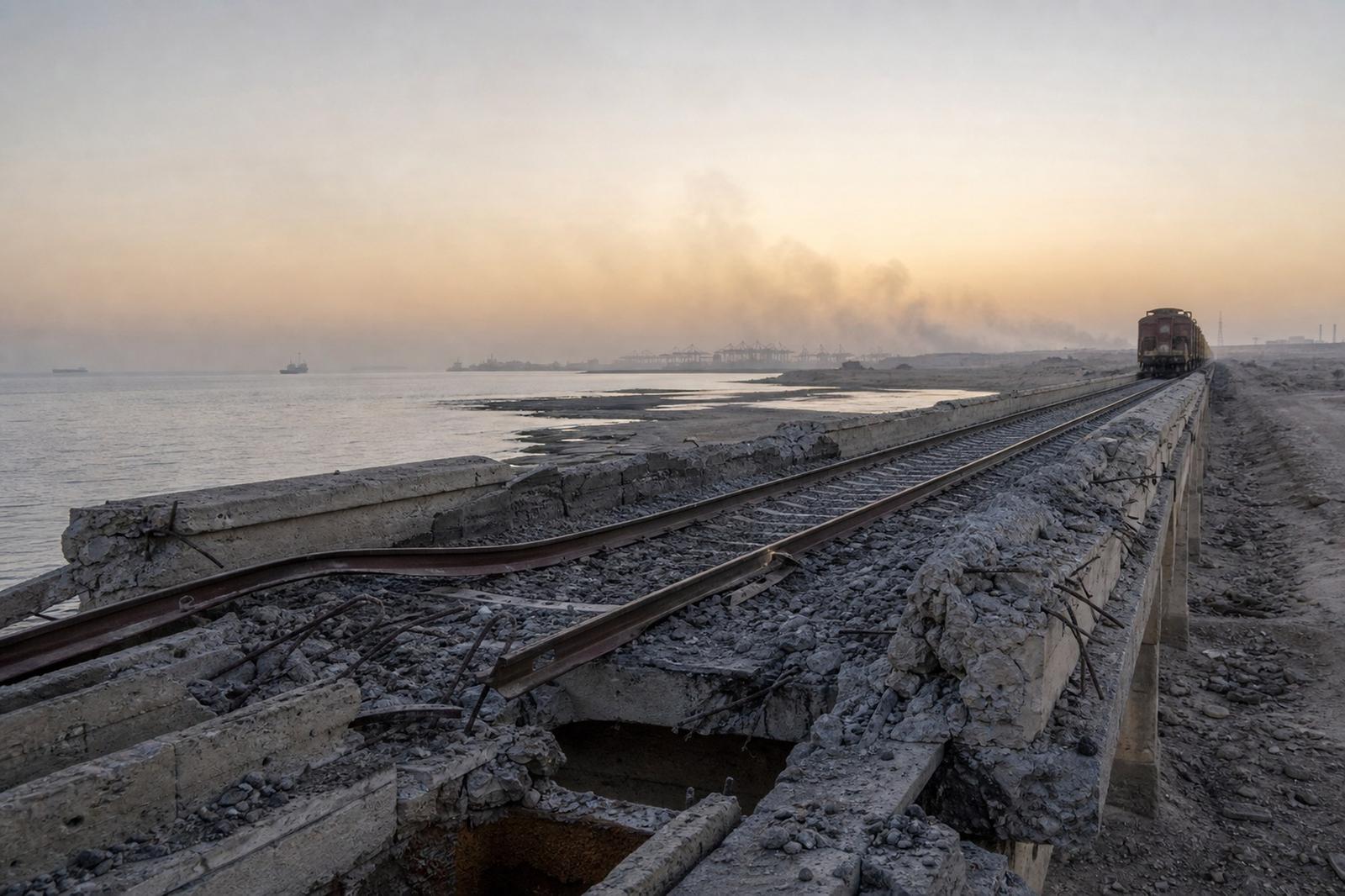
The United States and Iran have crossed another threshold in their renewed confrontation, directing attacks at infrastructure whose destruction can affect civilian transport, electricity and drinking water as well as military operations. American forces struck bridges and an airport in southern Iran early on Friday, while Tehran said it attacked facilities in Kuwait, Qatar, Bahrain and Oman.
The most consequential reported US attacks fell around Bandar Khamir in Hormozgan province. Iranian state media said at least five bridges were hit in the south and that seven people were killed near the port city, where the railway station was also struck. Reuters said it could not independently verify those reports. Farther east, Iranian media reported an attack on Iranshahr airport.
The operation completed a sixth consecutive night of American strikes. US Central Command said fighter aircraft, drones and warships had fired precision weapons at dozens of targets, including coastal surveillance and air-defence sites, maritime capabilities and military logistics infrastructure.
“US forces, including fighter jets, aerial drones, and warships, launched precision munitions that hit dozens of Iranian military targets such as coastal surveillance and air defense sites, military logistics infrastructure, and maritime capabilities,” US Central Command said.
The boundary around civilian infrastructure weakens
Friday's exchanges matter not simply because of their scale, but because of what was targeted. Bridges can carry troops and weapons, yet they also connect cities, supply shops and keep civilian economies moving. Desalination plants are even harder to separate from everyday survival in the Gulf, where fresh water is produced from the sea.
Kuwaiti authorities said an Iranian attack damaged a power-generation and water-desalination station, started a fire and put numerous generating units out of service. Firefighters brought the blaze under control, and technical teams began assessing the damage and restoring production. The Associated Press reported that roughly 90 per cent of Kuwait's drinking water comes from desalination.
Iran also announced attacks against Gulf states hosting American forces. Explosions were heard over Doha, where Qatar's Interior Ministry said falling debris wounded a child. Tehran said it had struck US-linked targets in Bahrain, Kuwait and Oman, as well as a target near Tanf in Syria. A Syrian military source told Reuters that the projectile landed near the former US base without causing casualties or damage.
The exchanges expose the vulnerability of countries that provide bases or logistical support to Washington but are also trying to contain the war. Qatar, alongside Pakistan, has served as a mediator. It nevertheless issued two shelter warnings on Friday as air defences responded to incoming missiles.
Pressure moves onto the Strait of Hormuz
The military escalation is inseparable from the contest over the Strait of Hormuz. Iran has announced the waterway's closure, while the United States has reinstated a blockade of Iranian ports. Washington says its campaign is intended to reduce Iran's ability to attack commercial shipping and force it to loosen its hold over the passage.
American forces said they had redirected three commercial vessels attempting to breach the blockade, disabled one that failed to comply and boarded another. Elsewhere in the strait, a tanker was struck by a projectile and sustained minor damage, according to the United Kingdom Maritime Trade Operations centre. No crew members were reported injured.
MarineTraffic recorded only eight vessel crossings on Thursday, a three-week low. Seven used an Iran-operated route, while none took the route nearer Oman. Some vessels may be sailing without transmitting their positions, but shipping intelligence groups say many operators are holding back rather than accepting the risk.
That disruption matters far beyond the Gulf. In peacetime, about a fifth of the world's traded oil and natural gas passed through the strait. Pipelines can divert part of the flow, but not enough to replace seaborne exports. Brent crude rose another 2 per cent on Friday to around $86 a barrel, its highest level since the interim agreement reached a month earlier.
A collapsed truce and shrinking room for restraint
The latest fighting follows the collapse of an interim agreement after Iran attacked shipping on 7 July and the United States resumed airstrikes. Until this week, the opponents had largely avoided major economic and civilian infrastructure because each knew retaliation could spread disruption across the region.
That restraint is now eroding. President Donald Trump had threatened attacks on Iranian bridges and energy facilities unless Tehran returned to negotiations. Iran, in turn, warned that attacks on its infrastructure would prompt strikes against comparable targets elsewhere in the Middle East.
Iran's Health Ministry said that, as of early Friday, recent American attacks had killed at least 38 people and wounded more than 400. The figures could not be independently confirmed. The United States describes its targets as military; reports of strikes on bridges, rail links and power infrastructure nevertheless make the distinction increasingly difficult to sustain on the ground.
The immediate question is whether the attacks are intended as coercive signals or mark the start of a broader campaign. Either path carries danger. Strikes calibrated to compel negotiations may instead produce retaliation, while damage to water, electricity and transport systems can outlast the military advantage sought from it. Around Hormuz, the margin for miscalculation is narrowing with every exchange.
Frequently asked
- What did the United States strike in Iran?
- US Central Command said it hit dozens of military targets, while Iranian media reported attacks on bridges, a railway station, an airport and port infrastructure.
- How did Iran respond?
- Iran announced attacks against countries hosting US forces, including Kuwait, Qatar and Bahrain. Kuwaiti authorities confirmed damage to a power and desalination plant.
- Why is the Strait of Hormuz central to the conflict?
- It is a major energy-shipping route. Iran has announced its closure, the United States is blockading Iranian ports, and vessel traffic has fallen sharply.
Sources
Around World
A look at recent reporting on world from the Étude newsroom.
Related by topic
Other Étude stories tagged with the same topics as this article.
More in World


Atari Relocates Its Legal Home to Luxembourg After Shareholders Back France Exit


How to buy a property in Luxembourg: the process, costs and notary
Trending at Étude
Russia's war economy Kyiv Holds the Line, and the West's Economic Weapons Start to Bite
Intelligence Japan launches its first central spy agency since 1945 to counter Russia and China
Cross-border rail CFL to halt all trains between Luxembourg and Thionville for five weeks this summer
Family finance Child Benefit in Luxembourg: Amounts and How to Claim the Allocations Familiales