Caribbean coast
Venezuela's Strongest Earthquake Since 1900 Brings Down Buildings Near Caracas
A magnitude-7.2 foreshock and a 7.5 main shock struck within a minute on Wednesday evening. The acting president reports at least 32 dead and 700 injured; the U.S. Geological Survey warns the final toll could be far higher.
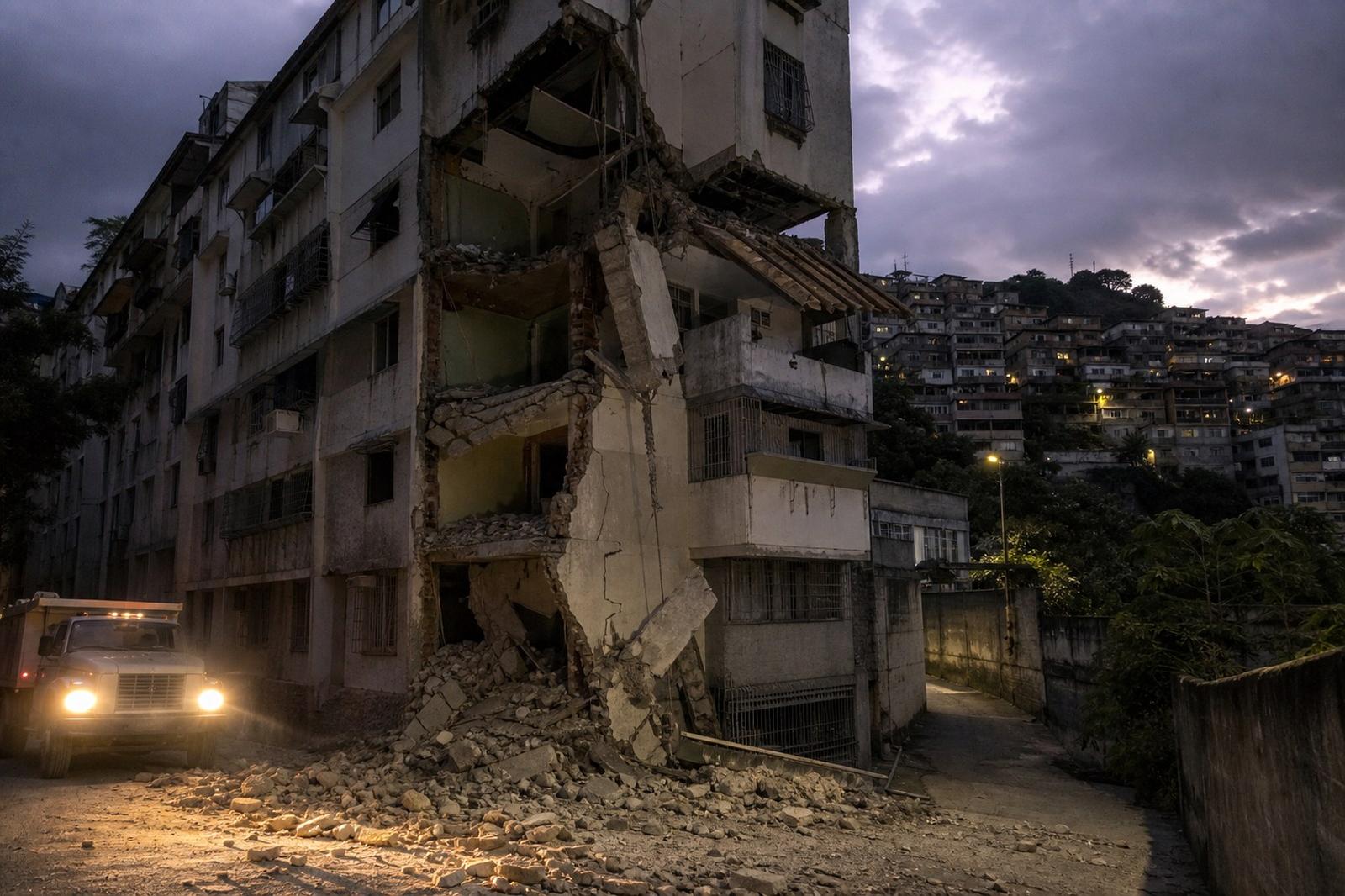
CARACAS — Two great earthquakes struck Venezuela's central Caribbean coast within the span of a minute on Wednesday evening, collapsing homes in the capital and across the surrounding states and forcing a country already deep in political crisis to begin digging through rubble in the dark.
The first tremor, a magnitude 7.2, hit at about 6:04 p.m. local time near the coastal town of Morón, roughly 160 kilometres west of Caracas. Less than a minute later an even stronger magnitude-7.5 shock ruptured the same stretch of fault. The United States Geological Survey called the pair a "doublet" and identified the larger jolt as the most powerful earthquake to strike Venezuela since 1900.
In a televised address late Wednesday, acting President Delcy Rodríguez said at least 32 people had been killed and more than 700 injured, and declared a state of emergency across the entire national territory. She stressed that the count was provisional. By Thursday morning rescuers were still pulling survivors from collapsed structures, and nearly two dozen aftershocks had been recorded.
A shallow rupture beneath a crowded coast
Both quakes were shallow — the USGS placed the first at about 22 kilometres deep and the second at roughly 10 — a geometry that channels the most violent shaking straight to the surface. The worst damage was reported in the Altamira and El Paraíso districts of Caracas, where apartment blocks pancaked onto the streets, and in the port city of La Guaira. The central states of Carabobo, Miranda and Trujillo also reported collapses. The shaking was felt as far away as Colombia and the Brazilian Amazon, more than 1,000 kilometres distant.
Authorities suspended classes nationwide and closed Simón Bolívar International Airport, the country's main gateway. The USGS issued a red alert — its highest — through its automated PAGER system, which models likely casualties before they can be counted on the ground.
"High casualties and extensive damage are probable and the disaster is likely widespread," the agency warned, estimating that deaths could ultimately run into the thousands and economic losses into the tens of billions of dollars.
The agency also put the probability of a magnitude-6 or larger aftershock in the same region over the following week at around 40 percent, a figure that hung over rescue crews working amid weakened buildings.
A government still finding its footing
The disaster has fallen on a state in the middle of an extraordinary transition. Nicolás Maduro, who governed Venezuela for more than a decade, was seized by United States forces in a January raid and is now in custody in New York, where he has pleaded not guilty to narcoterrorism charges. Ms Rodríguez, his vice-president, was sworn in as acting head of state days later and now confronts the largest natural disaster in the country's modern history with a depleted administration and an economy long in crisis.
That backdrop has complicated even the mechanics of relief. Venezuela's emergency services, hollowed out by years of sanctions, mismanagement and emigration, were quickly overwhelmed. Hospitals in Caracas treated the injured in corridors and car parks as power flickered across the capital.
Aid from the power that toppled Caracas
In a striking turn, the most prominent early offer of help came from Washington — the same government that ousted Venezuela's leader six months ago. Secretary of State Marco Rubio said the United States was "immediately deploying search and rescue teams, medical resources, and humanitarian assistance to Venezuela," and the State Department stood up a disaster task force to coordinate the effort. President Trump said the earthquakes had caused "a devastating number of deaths."
Rescue and medical teams were also pledged by the Dominican Republic, El Salvador, Mexico and Qatar, with further offers of aid from China, Brazil, Argentina, Bolivia, Chile, Ecuador, Panama and Uruguay. Whether and how quickly that assistance reaches the worst-hit neighbourhoods will be an early test of a government that has spent years treating foreign aid, and Washington in particular, with suspicion.
For now, the human picture remains incomplete. The gap between the 32 confirmed dead and the USGS's grim statistical forecast reflects how little is yet known about conditions in the towns nearest the epicentre, where communications were cut and roads blocked. In Caracas, residents spent the night outdoors, wary of returning to cracked buildings as the ground continued to move beneath them.
Frequently asked
- How strong were the earthquakes?
- The first measured magnitude 7.2 and was followed less than a minute later by a magnitude 7.5 shock — the strongest in Venezuela since 1900.
- How many people were killed?
- Acting President Delcy Rodríguez reported at least 32 dead and more than 700 injured, but warned the figures were provisional and the USGS expects them to rise.
- Where did the earthquakes hit?
- The epicentres were near the coastal town of Morón, about 160 km west of Caracas; the capital and central states suffered the heaviest damage.
- Which countries are sending help?
- The United States, the Dominican Republic, El Salvador, Mexico and Qatar pledged rescue and medical teams, with further offers from China, Brazil and several Latin American states.
Sources
Around World
A look at recent reporting on world from the Étude newsroom.
Related by topic
Other Étude stories tagged with the same topics as this article.
More in World


Trending at Étude
Financial regulation Luxembourg regulator will let Israeli bond prospectus expire on 31 August
Startup Guide How to Start and Fund a Startup in Luxembourg: A 2026 Founder's Guide
Culture Luxembourg's cuisine: the national dish and traditional classics
Languages Luxembourg's three official languages — Luxembourgish, French and German — and where each is used