Schengen borders
Airlines and airports urge EU to suspend new biometric border checks as queues reach five hours
Three months after the Entry/Exit System went fully live, Europe's aviation industry says the digital border has hit "a critical point" — and wants Brussels to allow it to be switched off at peak times through the summer.
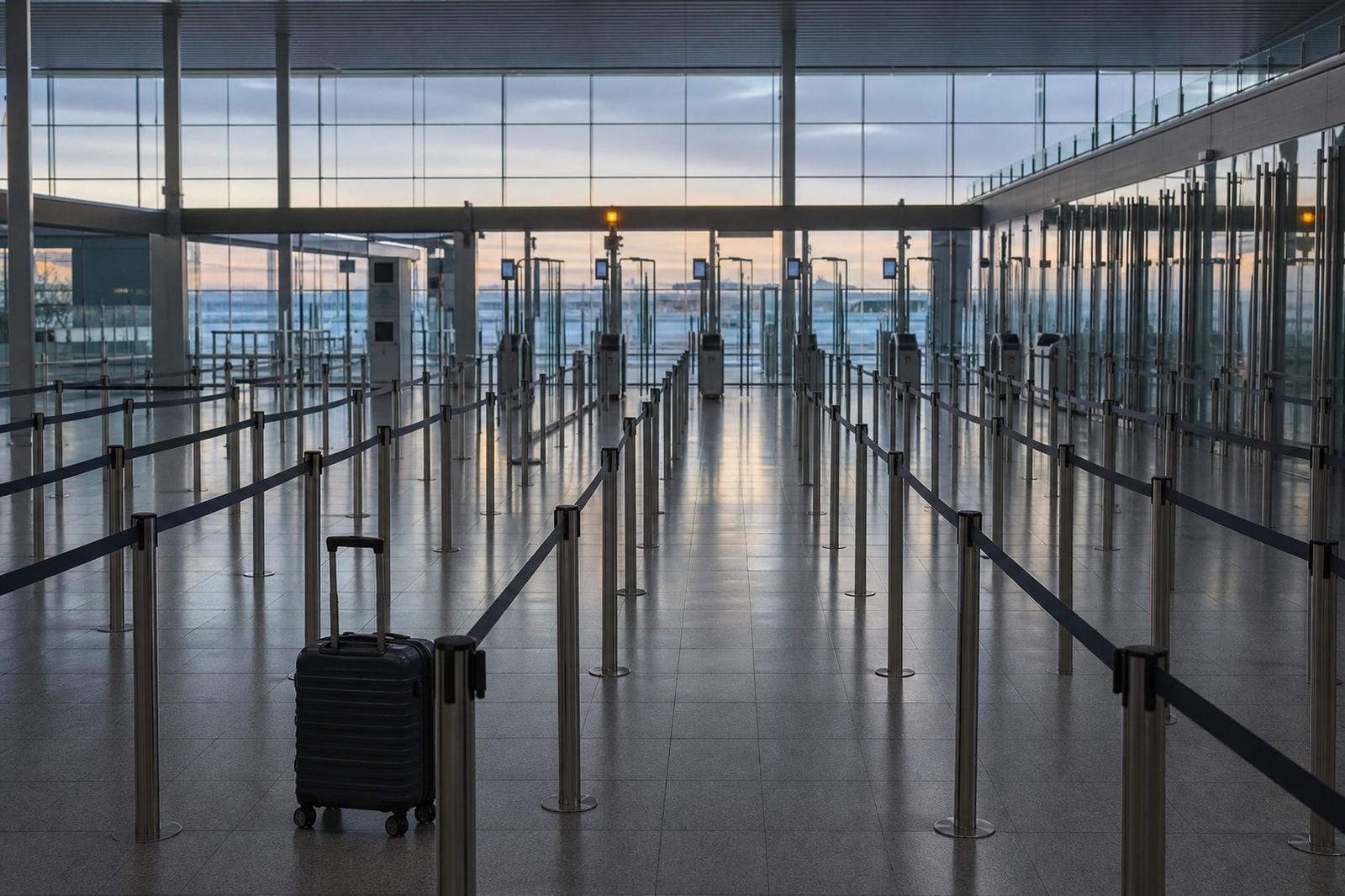
The European Union's new digital border was sold as the smart way to know, at last, exactly who enters and leaves the bloc. Three months after it became fully operational — and at the start of its first peak summer — the industry that carries those travellers is asking Brussels for permission to switch it off whenever the queues grow too long.
In an open letter published on Wednesday and addressed to European Commission President Ursula von der Leyen, the airports association ACI Europe, the carriers' group Airlines for Europe and the International Air Transport Association called for "immediate intervention", warning that the rollout of the Entry/Exit System, known as the EES, has reached "a critical point" just as tens of millions of holidaymakers head for Europe's airports.
“The current implementation of the EES is creating severe operational consequences, disrupting passengers and putting border authorities, airports and airlines under unsustainable pressure,” the three associations wrote.
Five-hour queues, half-empty planes
Since the system went fully live on 10 April, waiting times at passport control have lengthened sharply, reaching as much as five hours at peak periods. Carriers report aircraft pushing back half-empty at gate-closing time because passengers who should be on board are still trapped in border queues. The timing could hardly be worse: European airports expect roughly 40 million additional passengers in July and August compared with the previous two months.
The associations' central demand is blunt. Member states should be given the flexibility to suspend EES checks whenever passenger volumes exceed the operational capacity of a border crossing — at least throughout July and August — and the Commission should establish a permanent flexibility mechanism by September 2026.
The World Travel and Tourism Council has put numbers on the risk, warning that the delays could jeopardise up to 41 million arrivals and 45.4 billion dollars in visitor spending. “If lengthy delays become accepted practice, travellers will look elsewhere,” said the council's president, Gloria Guevara.
A border two decades in the making
First mooted in 2008, the EES began a phased rollout on 12 October 2025 and was declared fully operational on 10 April 2026 across 29 countries — every EU member state except Ireland and Cyprus, plus Iceland, Norway, Switzerland and Liechtenstein. It replaces the passport stamp with a digital record: non-EU nationals on short stays, a group that since Brexit includes every British traveller, must have their fingerprints and facial image captured at the border. The goal is to detect overstayers and identity fraud systematically rather than by leafing through ink stamps.
The trouble started early. Within hours of the full go-live in April, airports across the Schengen area saw waits of up to three hours, missed flights and stranded passengers, in what one industry account called a systemic failure. The Financial Times reported this week that officials have spent the months since fixing one glitch only to watch another appear — a battle its sources likened to a game of whack-a-mole.
Brussels, for its part, points to results. Since the launch:
- more than 40,000 people have been refused entry at the external border;
- more than 1,000 people have been identified as posing security risks to Europe.
Brussels calls an urgent meeting
A Commission spokesperson said efforts are “being made to limit the impact on travellers” and maintained that “in most EU airports the impact is limited”, while announcing an urgent meeting with member states and industry representatives. Frontex's deputy executive director has offered a longer horizon, saying the situation should stabilise within “one or two years” — an eternity for airlines staring at two lost summers, and cold comfort before the next layer of the digital border, the ETIAS travel authorisation, is added on top.
At Findel, 90 minutes early
Luxembourg is part of the story too. The EES has operated at Findel airport — the Grand Duchy's only border crossing point, since all its land borders are internal to Schengen — from the first day of the phased rollout in October 2025, deployed by the Grand Ducal Police together with lux-Airport. The airport now advises passengers to be at passport control at least an hour and a half before their flight, a margin that covers the biometric registration required of non-EU travellers, from visiting relatives to passengers on the London routes.
There is a certain irony in the geography. The system now straining Europe's external borders is the digital gatekeeper of the free-movement area named after Schengen, the Luxembourg village on the Moselle where the agreement abolishing internal borders was signed in 1985. Whether the first summer of the smart border ends in gridlock or in a quiet climbdown from Brussels will be decided in the coming weeks — at the e-gates, not in the treaties.
Frequently asked
- What is the EU Entry/Exit System (EES)?
- A biometric border system, fully operational since 10 April 2026 in 29 European countries, that replaces passport stamps by recording the fingerprints and facial image of non-EU nationals on short stays to detect overstayers and identity fraud.
- Who is affected by the EES checks?
- All non-EU nationals entering the Schengen area for short stays — including British travellers since Brexit. EU citizens and residents crossing internal Schengen borders are not subject to it.
- What does the aviation industry want?
- Permission for member states to suspend EES checks whenever passenger volumes exceed a border crossing's capacity, at least during July and August 2026, plus a permanent flexibility mechanism by September 2026.
- What does this mean for travellers using Luxembourg's Findel airport?
- The EES runs at Findel under the Grand Ducal Police, and lux-Airport advises being at passport control at least 90 minutes before departure; non-EU travellers must complete biometric registration there.
Sources
Around Europe
A look at recent reporting on europe from the Étude newsroom.
Related by topic
Other Étude stories tagged with the same topics as this article.
More in Europe


Luxembourg regulator will let Israeli bond prospectus expire on 31 August

Luxembourg public holidays 2026: the full list and what's open or closed

Trending at Étude
Languages Luxembourg's three official languages — Luxembourgish, French and German — and where each is used
Travel & Climate Weather and Climate in Luxembourg: What to Expect, Month by Month
Mobility Alzingen bypass: why Luxembourg is moving a EUR 390 million road bill now
Culture Luxembourg's cuisine: the national dish and traditional classics