Cross-border road freight
Luxembourg Customs will check tachographs in cross-border delivery vans
Commercial vans above 2.5 tonnes now face G2V2 recording, driving-time and posting obligations once their freight journey crosses a border.
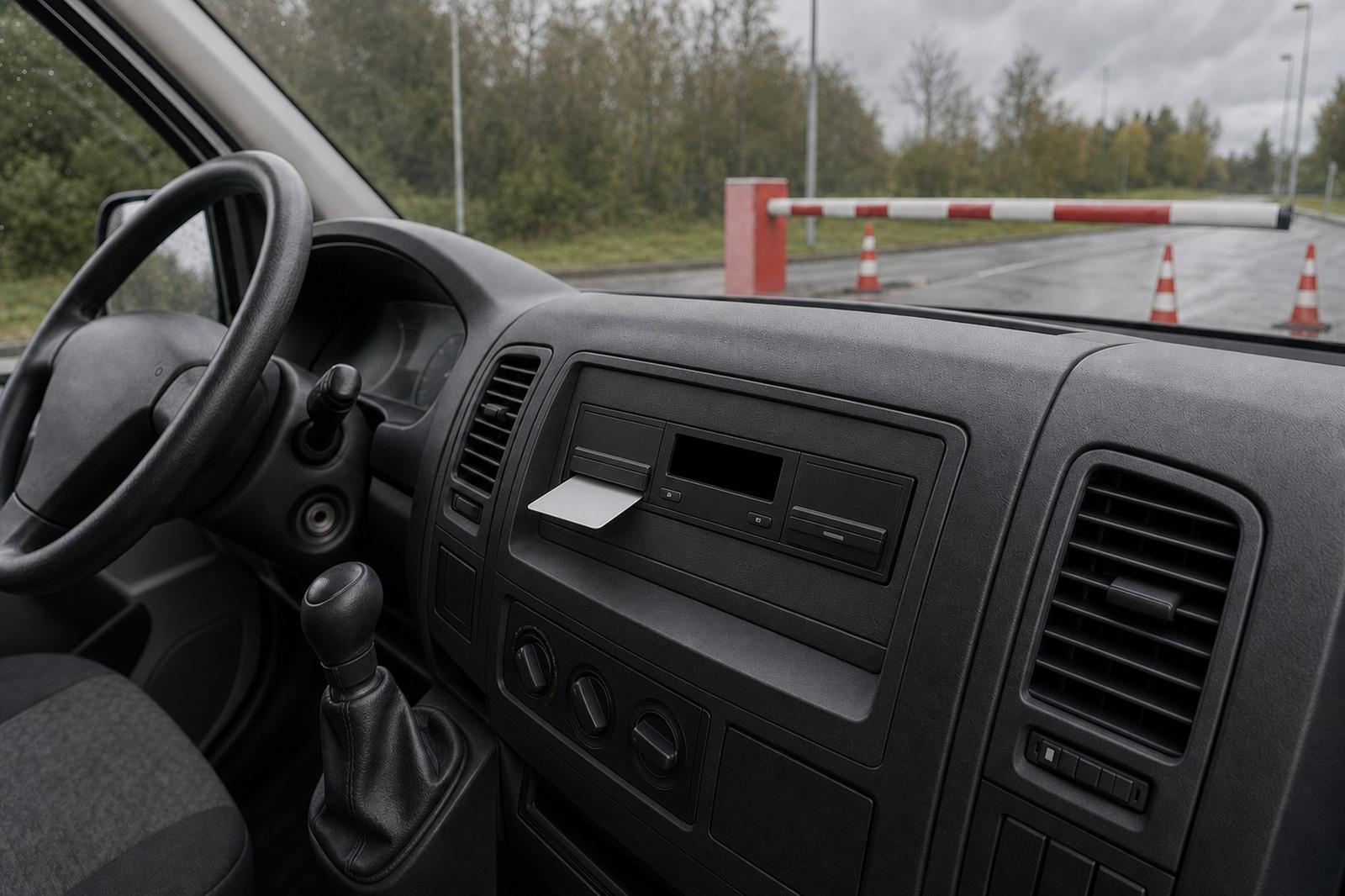
A delivery van crossing from Luxembourg into Belgium, France or Germany can no longer assume that the strict working-time regime of road haulage begins only with a full-sized lorry. Luxembourg’s Customs and Excise Administration says it will start checking whether qualifying light commercial vehicles carry and use the EU’s second-generation G2V2 smart tachograph. The move turns a regulatory deadline into an immediate operating question for couriers, small hauliers and other businesses moving goods for clients across a border.
The obligation has applied since 1 July 2026 under Mobility Package I. It does more than require a box in the dashboard: the same journey can now bring rules on maximum driving time, minimum breaks and rest, driver posting and documentary proof. Until July, that framework generally began above 3.5 tonnes. Its reach now extends down into a large part of the commercial-van market.
Which vans and journeys fall inside the rule
The extension covers vehicles or combinations with a maximum permissible mass above 2.5 tonnes and no more than 3.5 tonnes when they perform international carriage of goods or cabotage for hire or reward. A trailer or semi-trailer counts toward the threshold. What matters is the authorised mass in the vehicle documents, not merely the load measured during a particular trip.
Cabotage means domestic freight work performed in one member state by an operator established elsewhere. A Luxembourg company delivering between two points in another EU country can therefore fall within the regime. Drivers may be EU or non-EU nationals; the rules apply when they work for a transport undertaking established in the EU.
Not every van or foreign journey is covered. Transport remaining entirely within one country is outside this specific extension. An own-account operation in the 2.5-to-3.5-tonne band can also be exempt when the goods are not carried for a third party and driving is not the worker’s main activity. Non-commercial carriage remains excluded. Companies must assess the purpose of the operation rather than relying on the van’s appearance or business livery.
A workday measured like long-haul freight
The G2V2 tachograph records driving, breaks, rest, speed, distance and irregularities through the vehicle unit and the driver’s personal card. Its positioning and communication functions also give inspectors a stronger record of cross-border activity. Operators must organise routes so that the recorded schedule complies with the limits rather than treating the device as a passive tracker.
- Daily driving is normally limited to nine hours and may reach ten hours only twice in a week.
- Driving may not exceed 56 hours in one week or 90 hours across two consecutive weeks.
- A break of at least 45 minutes is required after four and a half hours of driving; it may be split into 15 and 30 minutes.
- Regular daily rest is at least 11 hours, while regular weekly rest is at least 45 hours.
The posting rules add a second labour dimension. Cabotage and cross-trade between countries where the employer is not established can make the driver a posted worker, potentially bringing the pay and employment conditions of the host state. Bilateral journeys from the operator’s home country and simple transit are generally treated differently. Where posting applies, drivers should have the declaration, freight documents and tachograph records available for inspection.
Luxembourg already has an enforcement record
The new checks fit an established Luxembourg practice. Customs examines transport documents, driving and rest records, vehicle condition and loads on the country’s main routes. In 2025 it issued penalty notices worth €1,462,056 during road controls. Of that total, €148,930 concerned breaches of driving and rest-time rules. Those figures predate the extension to lighter vans but show why the authority regards the recorded workday as a safety and competition issue.
Failure to respect driving and rest times remains the primary scourge in international road transport and must also be curbed in 2026 through both awareness and enforcement.
Luxembourg Customs and Excise Administration, January 2026
For compliant operators, the policy is also about the price of competition. A business that schedules legal breaks, limits shifts and equips its fleet carries costs that a rival can avoid by sending an unrecorded van on an excessive run. Extending the same basic rules below 3.5 tonnes is intended to reduce that gap while limiting fatigue on roads used heavily by international freight.
What operators should be able to show
- Check the authorised combined mass of every van-and-trailer configuration.
- Confirm whether each journey is international, cabotage, domestic or genuinely exempt own-account work.
- Have the G2V2 unit installed, calibrated and used with valid driver and company cards.
- Plan legal breaks and retain the transport, posting and activity records required for an inspection.
The practical dividing line is therefore no longer simply van versus lorry. It is the vehicle’s authorised mass, the commercial purpose of the load and the geography of the job. For Luxembourg businesses accustomed to crossing a border within minutes, that combination now has to be checked before the driver leaves the depot.
Frequently asked
- Does every commercial van need a tachograph?
- No. The July extension targets vehicles or combinations above 2.5 tonnes and up to 3.5 tonnes used for international freight or cabotage for hire or reward.
- Is an international trip automatically covered?
- Not always. Own-account carriage may be exempt when driving is not the worker’s main activity, while non-commercial and purely domestic transport are outside this extension.
- What will inspectors examine?
- They can check the G2V2 unit and driver card, recorded driving and rest periods, the vehicle and freight documents, and any required posting declaration.
Sources
Around Luxembourg
A look at recent reporting on luxembourg from the Étude newsroom.
More in Luxembourg

Kyiv Holds the Line, and the West's Economic Weapons Start to Bite

The Scarcest Thing in Tech Is Now a Computer


Trending at Étude
Crime Luxembourg Police Handle 41,489 Cases as Violent Robberies Rise 30.8%
United Kingdom Starmer Quits, and Britain Lines Up Its Seventh Prime Minister in a Decade
Critical minerals Washington Backs a Kazakh Tungsten Mine. The President's Sons Are Inside the Deal.
Newcomer's guide How Healthcare Works in Luxembourg, and How to Register With the CNS