Cross-border emergency
Luxembourg sends firefighters as High Fens blaze burns at least 1,600 hectares
Smoke has reached the Grand Duchy while international crews battle a peat fire larger than the High Fens disaster of 2011.
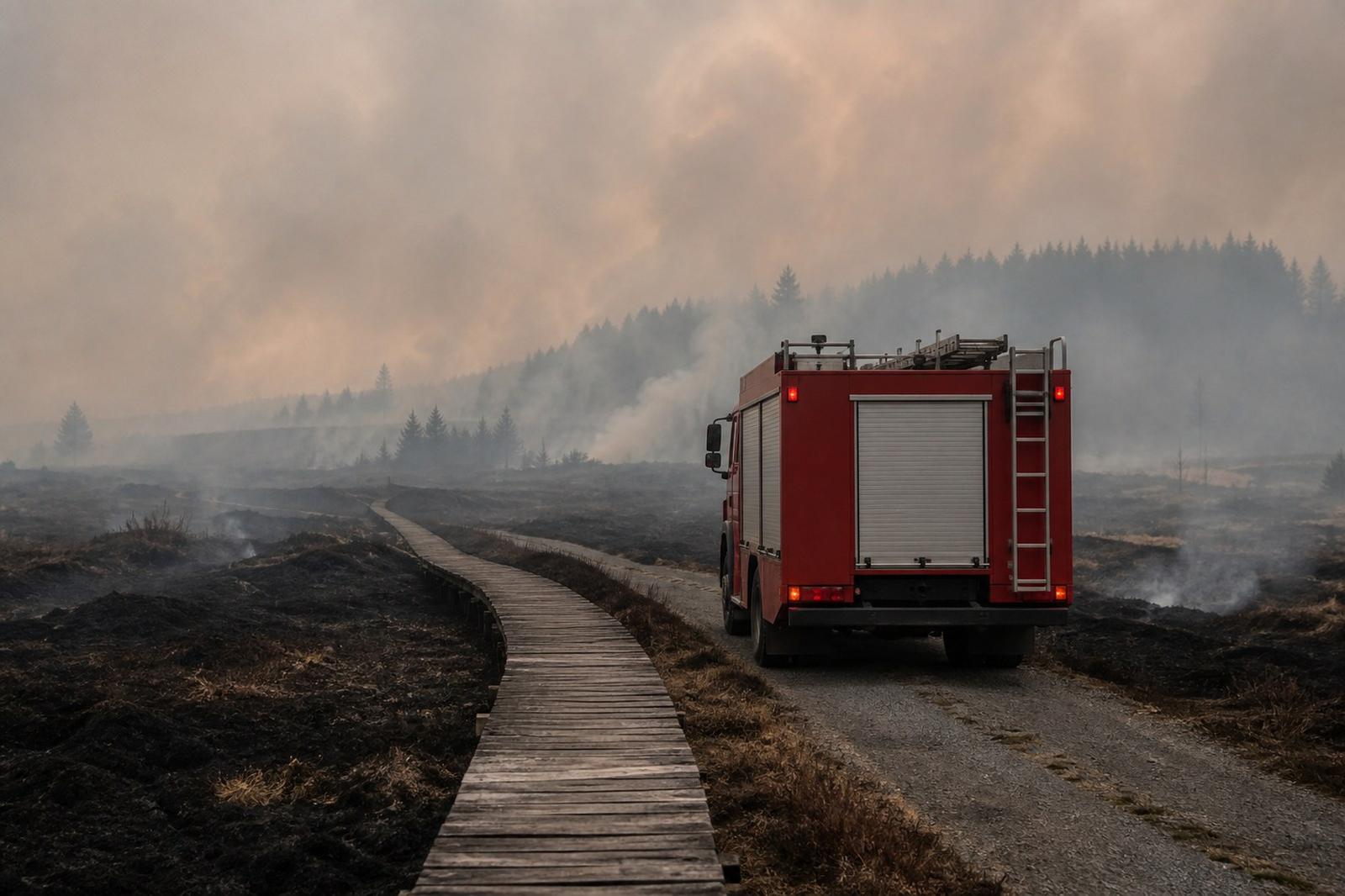
Luxembourg has sent firefighters to Belgium as a fast-moving wildfire in the High Fens spreads smoke across the border and tests the Greater Region’s ability to respond to a large natural disaster. At least 1,600 hectares had burned by Saturday, according to the Walloon public service as cited by NOS. Later aerial reporting by RTL Info put the affected area at about 1,800 hectares.
The fire began on Friday afternoon in the Belgian peatlands and was still expanding in the latest verified operational reports. Belgian firefighters estimated that its front had at times advanced by five to ten kilometres an hour. The cause has not been established.
The figures already make this fire larger than the major High Fens blaze of April 2011, when about 1,200 hectares of vegetation burned. The comparison matters because the earlier disaster shaped Belgian prevention measures and remained the modern benchmark for fire risk in this normally wet landscape.
Dry peat turns one fire into a prolonged operation
The High Fens are not an ordinary forest. Their peat was created from compressed plant material in waterlogged ground, but sustained drought can turn the upper layers into fuel. Fire may then smoulder below the visible surface and reappear after flames seem to have been extinguished.
That combination of dry peat, difficult terrain and changing wind has complicated the response. Some sections are hard to reach with heavy vehicles, while a shift in wind direction can move both the fire and its smoke. Authorities asked residents near the reserve and visitors to stay away from wooded areas. People in affected communities were also advised to close windows and doors, and several roads were shut.
The smoke plume was visible above Baelen and travelled far beyond the immediate fire zone. Reports of smoke or its smell came from Luxembourg as well as neighbouring parts of Germany and the Netherlands. Smoke at a distance does not show where a fire front is moving, but it demonstrates the regional scale of the incident.
“When it’s warmer and drier outside, and there’s been little rain, the risk of forest fires here in Luxembourg goes up.”
Colonel Steve Meyer of the CGDIS, speaking in July about vegetation-fire conditions in Luxembourg
A multinational response built around scarce equipment
Belgium’s response has drawn assistance from several directions. The Netherlands dispatched two Chinook helicopters to support aerial firefighting. Crews from Germany and Belgian Limburg joined the operation, while the Belgian military sent three Panther fire engines. Each of those vehicles can carry 10,500 litres of water and project a stream over a distance of up to 90 metres, according to NOS.
Farmers also helped by using tractors and water tanks to wet roadsides. Their role illustrates one of the central problems in a peatland fire: crews need large quantities of water close to ground that conventional tankers cannot always cross safely.
Luxembourg’s deployment adds another operational link to that network. The CGDIS has experience in cross-border fire support and had already sent personnel and equipment to major fires in France earlier this summer. The Belgian mission is more immediate for residents at home because smoke is crossing into the Grand Duchy and the fire is burning within the wider region’s daily travel radius.
A separate wildfire was burning roughly 35 kilometres away in Germany’s Hürtgenwald. About 400 hectares had burned there, and around 2,000 residents of Gey were evacuated. Unexploded Second World War munitions complicated that operation. Although the two fires are distinct, their proximity has increased pressure on specialist crews and aircraft across the border region.
What remains uncertain
Three questions will determine the next phase: whether rain penetrates the peat rather than merely wetting its surface, whether changing winds create new fire fronts, and how much of the reserve has suffered deep rather than superficial burning. A mapped perimeter is not the same as a final ecological damage assessment.
The High Fens contain peatland, heath, forest and habitats restored over many years. Fire can move unevenly through that mosaic, leaving intact islands inside a broad affected zone. Officials will need ground surveys before stating how much protected habitat has been destroyed.
For Luxembourg, the immediate facts are narrower. Firefighters have gone to reinforce the Belgian operation, smoke has reached the country, and the CGDIS’s existing warning about exceptionally dry vegetation remains relevant. Residents should follow official alerts rather than infer local danger from the colour or smell of the sky, because smoke can travel far from the active flames.
No verified source had identified the cause by the latest reporting. Nor was there a confirmed final figure for the burned area. Both may change as crews gain access and authorities consolidate aerial measurements. What is already clear is that a landscape associated with water and bog has produced one of the Greater Region’s largest fire operations in years.
Frequently asked
- Where is the High Fens wildfire?
- The main fire is burning in the High Fens peatland of eastern Belgium, including territory around Baelen in the province of Liège.
- Why has Luxembourg sent firefighters?
- Luxembourg is reinforcing the cross-border response to a large and still-expanding fire whose smoke has also reached the Grand Duchy.
- Why is a peat fire difficult to extinguish?
- Dry peat can burn or smoulder below the surface, while soft ground restricts access for heavy firefighting vehicles.
Sources
Around Greater Region
A look at recent reporting on greater region from the Étude newsroom.
Related by topic
Other Étude stories tagged with the same topics as this article.
More in Greater Region

Luxembourg public holidays 2026: the full list and what's open or closed

Luxembourg regulator will let Israeli bond prospectus expire on 31 August

Trending at Étude
Explainer The Grand Duchy of Luxembourg: Its Monarchy and How the Country Is Governed
Travel & Climate Weather and Climate in Luxembourg: What to Expect, Month by Month
Mobility Alzingen bypass: why Luxembourg is moving a EUR 390 million road bill now
Money & Work Unemployment benefits in Luxembourg: who qualifies and how much is paid