City Guide
Luxembourg City: fortifications, casemates and museums to see in a day or two
A UNESCO-listed fortress capital of clifftop ramparts, underground tunnels and free transport — here is how to see the best of it in a day or two.

Luxembourg City is one of Europe's most underrated capitals — a compact, dramatic place where a medieval fortress, deep river gorges and a modern banking quarter sit side by side. The historic centre and its defences were inscribed on the UNESCO World Heritage List in 1994 as "City of Luxembourg: its Old Quarters and Fortifications," recognising one of Europe's greatest fortified sites. Because all buses, trams and trains across the country have been free since 2020, getting around costs nothing.
Walk the fortress and its underground tunnels
The city was carved out of sheer rock above the Alzette and Pétrusse valleys, and for centuries it was so heavily defended it earned the nickname the "Gibraltar of the North." The best way to feel that history is to go underground.
- Bock Casemates — A network of defensive tunnels first cut into the rock by the Spanish in 1644 and later extended; part of a system that once ran more than 23 km. You can explore them on your own and peer out through cannon loopholes over the valley.
- Chemin de la Corniche — A 17th-century rampart walk that the writer Batty Weber called "the most beautiful balcony in Europe." It runs from the Bock promontory along the Alzette gorge with sweeping views over the lower town.
- Musée Dräi Eechelen — Set inside the restored Fort Thüngen at Kirchberg, it tells the story of the fortress and the nation.
Descend to the lower towns
Below the ramparts lie two of the city's most photogenic quarters, threaded by the little Alzette river.
- The Grund — A cobbled riverside village of old houses, bridges and lively bars and restaurants, directly beneath the Corniche.
- Pfaffenthal — A quiet valley district reached by the free Pfaffenthal panoramic lift, a glass elevator rising 71 metres between Pescatore park in the upper town and the valley floor. It is free of charge and open from early morning until 1am, offering a thrilling view on the way down.
See the old town's grand squares
The Ville Haute (upper town) is a tangle of pedestrian streets, squares and monuments, all within a short walk of one another.
- Grand Ducal Palace — The official town residence of the Grand Duke; its Flemish Renaissance facade is among the city's most photographed buildings. Guided interior tours run in summer.
- Place Guillaume II (Knuedler) — The city's main square, hosting a lively produce market on Wednesdays and Saturdays.
- Place d'Armes — A leafy, café-lined square that is the social heart of the old town, perfect for people-watching.
- Notre-Dame Cathedral — A 17th-century church blending late Gothic and Renaissance styles, with a striking crypt.
Cross to Kirchberg for modern art and music
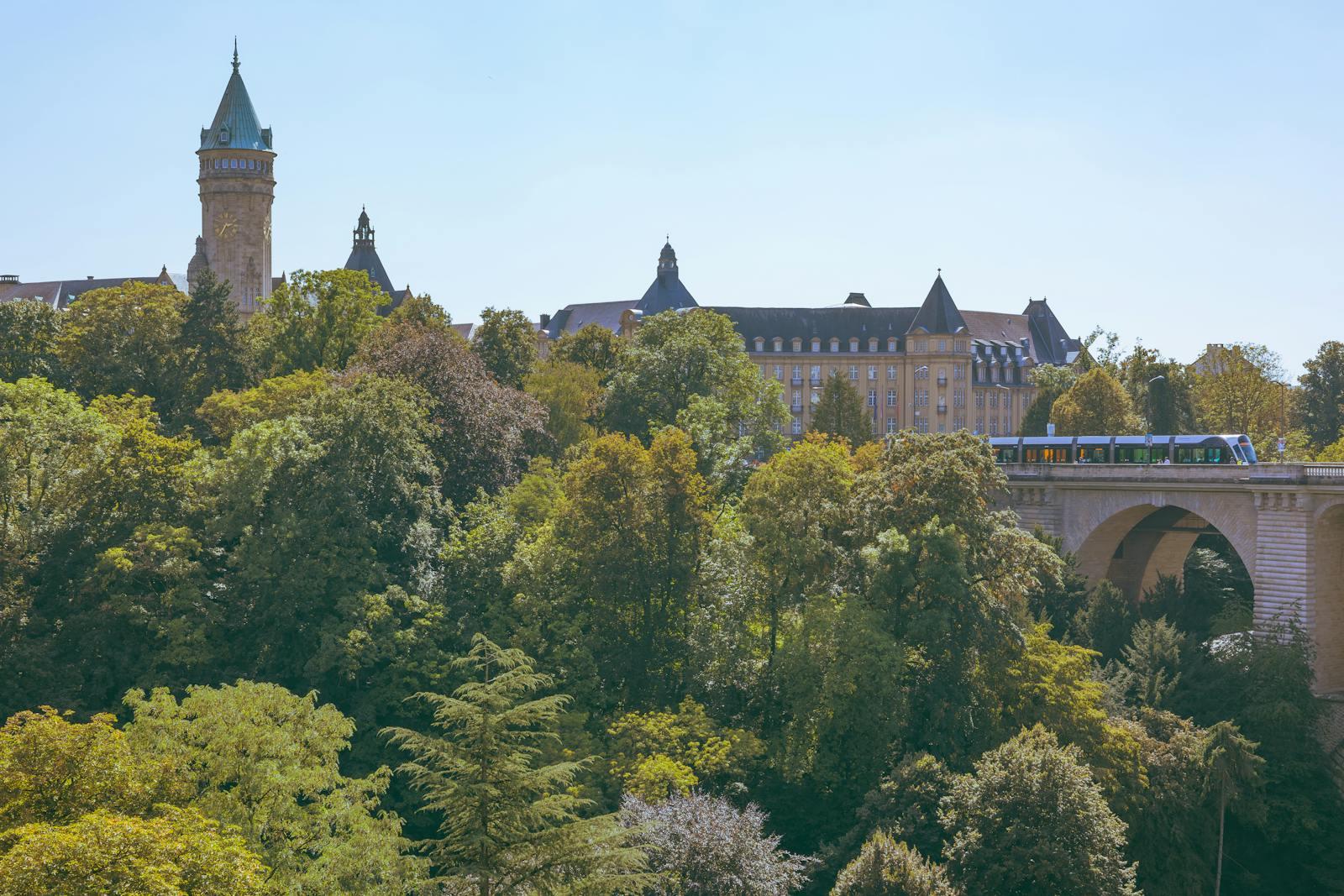
A short tram or walk across the Adolphe Bridge — a graceful stone arch over the Pétrusse, a symbol of the city — or out to the Kirchberg plateau brings you to the contemporary side of the capital.
- Mudam — The Musée d'Art Moderne Grand-Duc Jean, designed by Pritzker Prize-winning architect I. M. Pei and built into the ruins of Fort Thüngen. It opened in 2006 and is Luxembourg's flagship modern-art museum.
- Philharmonie Luxembourg — The striking colonnaded concert hall next door, on the Place de l'Europe.
Practical tips
The centre is compact and walkable, but steep, so wear good shoes. Markets, the casemates and the panoramic lift are seasonal, so check opening dates before you go. With transport free nationwide, it is easy to pair the capital with a day trip to the wine-growing Moselle or the castles of the north. Allow at least a full day for the old town and lower towns, and a second day for Kirchberg's museums.
Frequently asked
- Is Luxembourg City a UNESCO World Heritage Site?
- Yes. The 'City of Luxembourg: its Old Quarters and Fortifications' was inscribed on the UNESCO World Heritage List in 1994, recognising one of Europe's greatest fortified sites.
- Is public transport really free in Luxembourg?
- Yes. Since 2020 all buses, trams and trains across the entire country are free for residents and tourists alike (only 1st-class train tickets are still paid).
- Are the Bock Casemates worth visiting?
- Yes. They are a network of defensive tunnels cut into the rock from 1644, once part of a 23 km system, and you can explore them independently with views over the valley.
- Is the Pfaffenthal panoramic lift free?
- Yes. The glass lift is free of charge, rises 71 metres between Pescatore park and the Pfaffenthal valley, and runs from early morning until 1am.
- How long do you need in Luxembourg City?
- Allow at least a full day for the UNESCO old town, casemates and lower towns, and a second day for the Kirchberg museums such as Mudam.
- What is the Chemin de la Corniche?
- It is a pedestrian walk along the 17th-century city ramparts above the Alzette valley, famously called 'the most beautiful balcony in Europe.'
Around Culture
A look at recent reporting on culture from the Étude newsroom.
Related by topic
Other Étude stories tagged with the same topics as this article.
More in Culture


How to buy a property in Luxembourg: the process, costs and notary

Kyiv Holds the Line, and the West's Economic Weapons Start to Bite
Trending at Étude
Somalia Somalia Prepares First Offshore Oil Drilling After Decades of Delays
Cross-border rail CFL to halt all trains between Luxembourg and Thionville for five weeks this summer
The compute crunch The Scarcest Thing in Tech Is Now a Computer
Demography Japan Records a 10th Consecutive Record-Low Birth Year as South Korea's Fertility Rate Rises