Panthéon
The Historian the Gestapo Killed Takes His Place in the Panthéon
The scholar-soldier executed by the Germans in 1944 enters France's temple of memory — as his family rebuffs the far right's attempt to claim him.
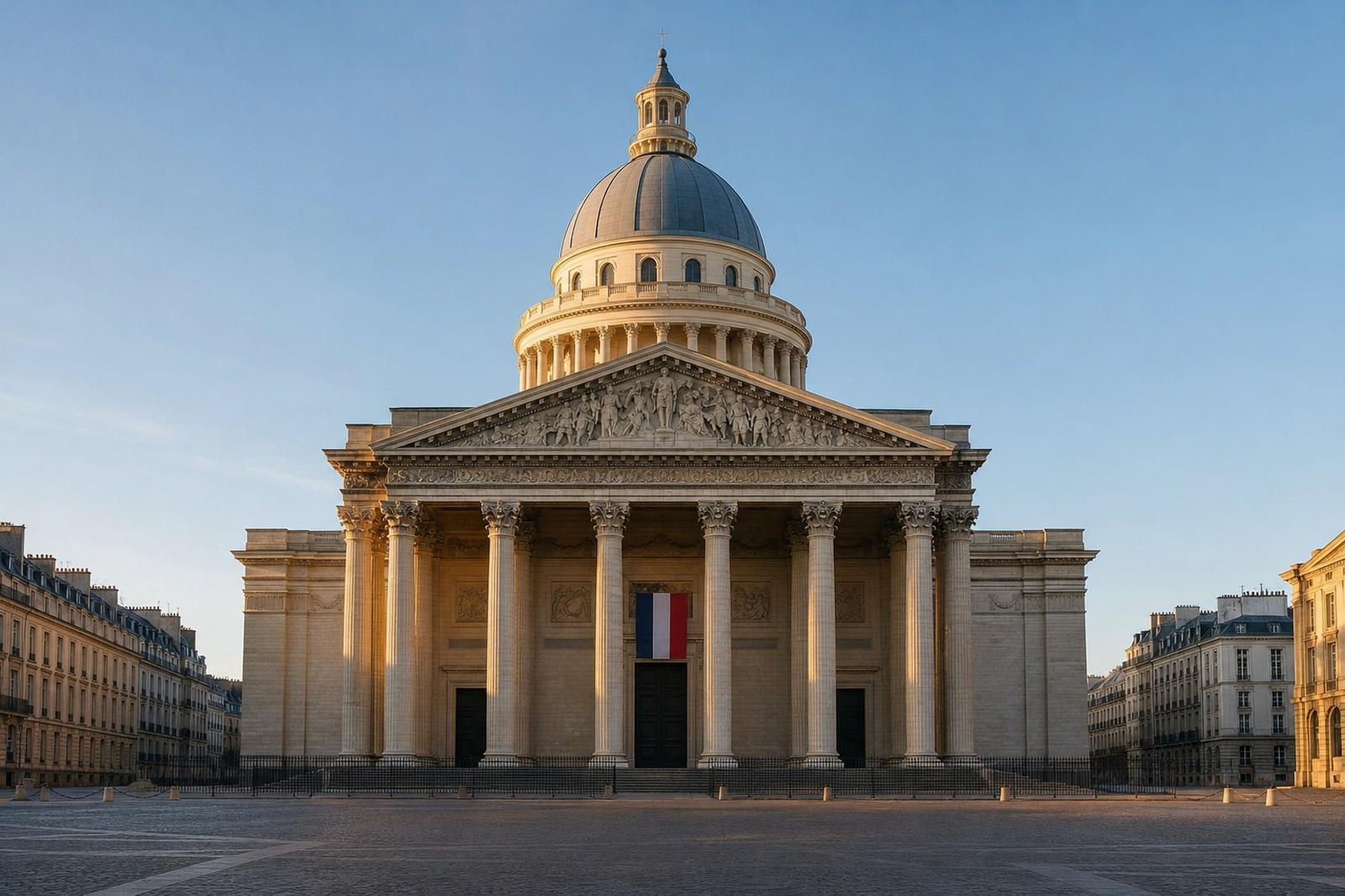
PARIS — More than eight decades after a German firing squad killed him in a field outside Lyon, Marc Bloch entered the Panthéon on Tuesday, becoming the first historian to be honoured in France's secular temple of national memory.
The ceremony, presided over by President Emmanuel Macron, paid tribute to a figure who was at once a scholar of rare influence and a soldier of both world wars: co-founder of the Annales school that remade the writing of history, and a member of the Resistance who was arrested, tortured and shot in 1944. Bloch was enshrined alongside his wife, Simonne, whose body was never recovered. Macron called him “a man of the Enlightenment in the army of the shadows.”
The president had announced the decision in November 2024, on the eightieth anniversary of the liberation of Strasbourg, saying the Republic would honour Bloch “for his work, his teaching and his courage.”
A scholar who chose to fight
Bloch was born in 1886 into an Alsatian Jewish family that had chosen France after the region was annexed by Germany in 1871 — a lineage he later said bound him to the nation by gratitude rather than blood. He fought in the trenches of the First World War and, though past fifty, enlisted again in 1939.
His scholarship reshaped a discipline. With Lucien Febvre he founded the Annales in 1929, turning history away from the chronicle of kings and battles toward the slow movements of societies, economies and beliefs. Among the works still set in universities far beyond France:
- “The Royal Touch” (1924), on the supposed healing powers of medieval kings;
- “Feudal Society,” his synthesis of the medieval West;
- “Strange Defeat,” his cold autopsy of France's collapse in 1940;
- “The Historian's Craft,” left unfinished at his death.
After the defeat of 1940 Bloch joined the clandestine Franc-Tireur network in Lyon. He was arrested by the Germans on 8 March 1944, held and tortured at Montluc prison, and executed on 16 June at Saint-Didier-de-Formans, in the Ain. He was fifty-seven.
A memory others would claim
That a Jewish résistant murdered by the Gestapo should be canonised by the Republic might seem beyond dispute. Yet the days before the ceremony were consumed by an argument over who may invoke him. For two decades, parts of the French far right have cited Bloch to lend a patriotic gloss to a narrative of national identity — an appropriation his descendants consider a desecration.
The family asked that the far right, “in all its forms,” be kept away from the Panthéon. The Rassemblement National said it would send no representatives. His granddaughter, Suzette Bloch, was unsparing, calling the party the heirs of the Waffen-SS who killed her grandfather and insisting that Bloch had been “antifascist,” “a democrat, a man of the left.”
The historian had anticipated the quarrel in his own way. In a testament written in 1941, he set down the terms on which he understood his Jewishness and his Frenchness:
“I am a Jew … I never lay claim to my origins save in one case: when facing an antisemite.”
Why it matters now
Bloch's induction lands at a moment when far-right parties are ascendant across Europe and the meaning of national belonging is again contested. The ceremony framed him less as a relic than as an argument: that patriotism and pluralism are not opposites, and that the careful, evidence-bound study of the past is itself a civic act. He had asked that his tomb carry two words, “Dilexit Veritatem” — he loved truth.
The Panthéon is marking the induction with an exhibition, “Marc Bloch, l'esprit de l'Histoire,” and France's cultural institutions have declared 2026 a Bloch anniversary year. The historian was shot as the Allies prepared to land in Normandy, his scholarship cut off mid-sentence; the manuscript of “The Historian's Craft” survived him unfinished. On Tuesday the Republic placed him, at last, among the figures it asks its citizens to remember.
Frequently asked
- Who was Marc Bloch?
- A French historian, co-founder of the Annales school, and a Resistance fighter executed by the Germans in 1944.
- Why was his induction controversial?
- Parts of the far right have invoked him, but his family and many historians say his values are opposed to theirs, and the Rassemblement National was kept from the ceremony.
- Is he the first historian in the Panthéon?
- He is the first historian to be enshrined there.
Sources
Around Culture
A look at recent reporting on culture from the Étude newsroom.
Related by topic
Other Étude stories tagged with the same topics as this article.
More in Culture



Trending at Étude
Financial regulation Luxembourg regulator will let Israeli bond prospectus expire on 31 August
Startup Guide How to Start and Fund a Startup in Luxembourg: A 2026 Founder's Guide
Culture Luxembourg's cuisine: the national dish and traditional classics
Languages Luxembourg's three official languages — Luxembourgish, French and German — and where each is used