Launch economics
Europe's Sovereign Rocket Now Flies on Amazon's Cargo
Arianespace has put its 100th Amazon satellite in orbit. The economics that keep Ariane 6 aloft run through Jeff Bezos — and, quietly, through Luxembourg.
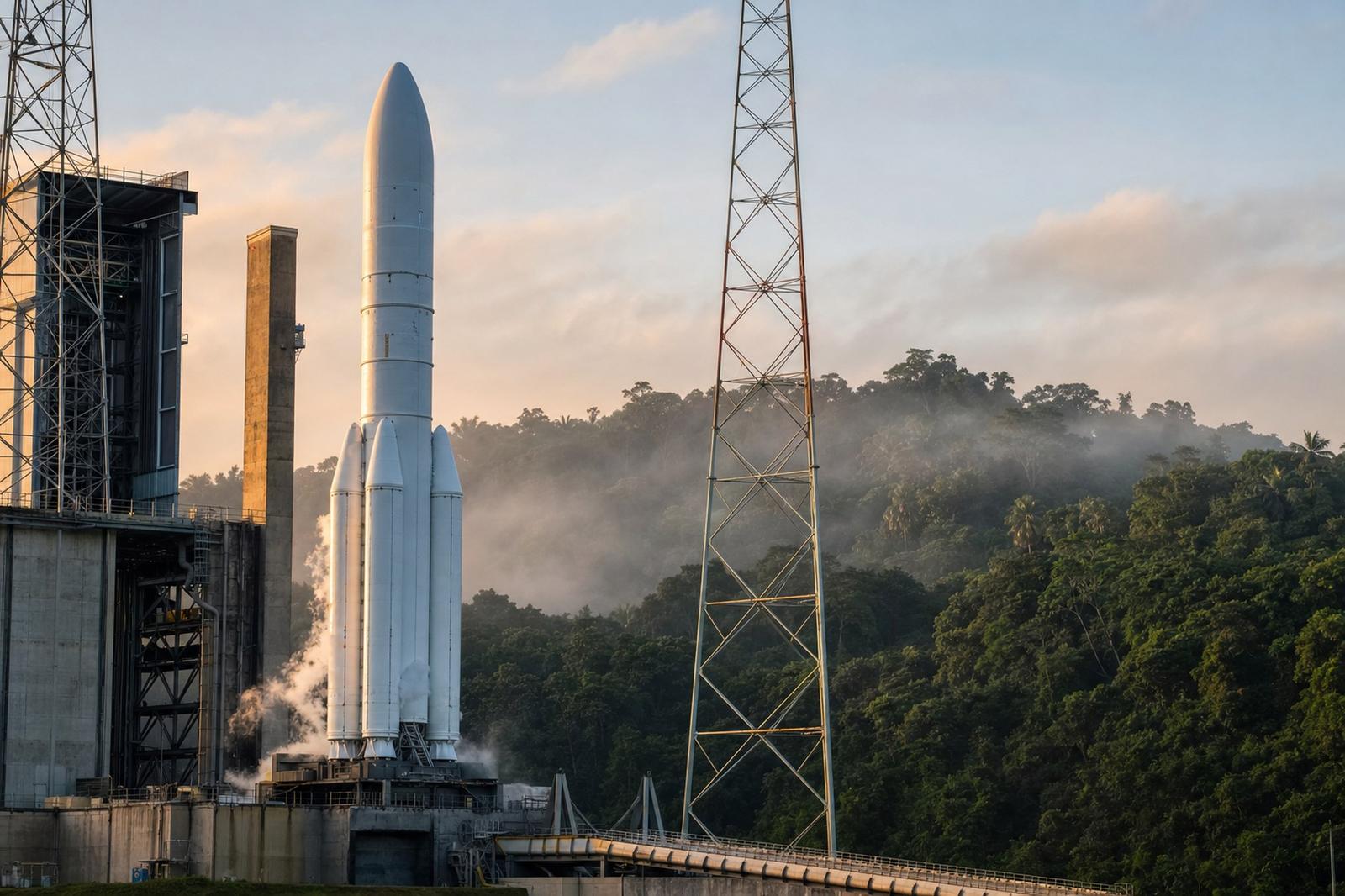
The most powerful rocket Europe has ever flown lifted off from the jungle spaceport at Kourou on 17 June, and the heaviest payload an Ariane has ever carried to orbit did not belong to a European government, a European broadcaster or a European army. It belonged to Amazon.
The flight — 36 satellites for Amazon Leo, the e-commerce group's answer to Starlink — let Arianespace claim a milestone it was glad to publicise: 100 satellites delivered for a single American customer in under five months, across three missions of the upgraded Ariane 64. The launcher sold to the continent as the guarantor of its independence in space is, for now, kept busiest by the cargo of a company controlled by Jeff Bezos.
With 100 satellites now placed in orbit by Arianespace for Amazon Leo and the launch of 4 more satellites than the first two missions, we are setting records with an increasingly powerful and versatile launcher.
David Cavaillolès, chief executive of Arianespace
A record built on someone else's satellites
The Ariane 64 is the four-booster configuration of Europe's new heavy launcher, a 62-metre vehicle able to place some 21.6 tonnes in low Earth orbit. It made its debut on 12 February, when ESA's space transport director, Toni Tolker-Nielsen, said the flight "sustains Europe's autonomous access to space." Three launches followed in quick succession — 32 satellites in February, 32 in April, 36 in June — and the rhythm is set to continue, with up to eight Ariane 6 flights planned this year, double the four managed in 2025.
Underwriting that manifest is a single document: the 18-launch contract Amazon signed with Arianespace, the largest commercial order in the European company's history. It is the ballast that turns a politically necessary rocket into a commercially active one.
One billionaire's rocket, another billionaire's war
The arrangement carries an irony the industry has not failed to notice. Ariane 6 was conceived as Europe's reply to SpaceX, and made urgent by the loss of Russia's Soyuz after the 2022 invasion of Ukraine. Yet the demand now filling its calendar comes from Mr Bezos, who also owns the SpaceX rival Blue Origin and whose Amazon Leo network exists to contest Elon Musk's Starlink for the low-orbit broadband market. SpaceX flew roughly 65 percent of the world's commercial launches in 2024. Europe's sovereign launcher, put plainly, is being kept aloft by one tech magnate's campaign against another.
Arianespace frames the dependency as vindication rather than weakness. "Autonomous access to space is one of our missions, and has been for decades," Mr Cavaillolès has said; what has changed, he argues, is that governments now grasp what sovereign launch capacity is worth. The rocket is the work of some 600 firms across the continent, with France funding 55.3 percent of its development, Germany 21 percent and Italy 7.6 percent, and ten other member states — Luxembourg among them — covering the rest.
Why the story runs through Betzdorf
Luxembourg's interest in all of this is not abstract. The Grand Duchy is home to SES, the satellite operator headquartered at Betzdorf since 1985 and running a fleet of more than 70 spacecraft in geostationary and medium Earth orbit. Through GovSat, a fifty-fifty venture with the state, the country also owns a piece of Europe's secure military communications. And as an ESA member, Luxembourg helps pay for Ariane directly: a bill before parliament earmarks €265.1 million for European space programmes between 2026 and 2029, €66.59 million more than the previous period, with a dedicated line for launcher development.
That gives the country a double exposure:
- As a contributor to ESA, it has a sovereignty stake in keeping Ariane flying — and in not depending on American or Russian rockets to reach orbit.
- As the home of SES, it has a commercial stake on the other side of the ledger, because the very low-orbit boom now filling Ariane's manifest is what threatens the geostationary business SES was built on.
The constellations Arianespace is lofting for Amazon — and the ones SpaceX lofts for itself — are rewiring how the world buys connectivity, from broadband to broadcast. For a small country that has staked a slice of its economy on space, the June launch was a reminder that the orbits overhead mean money, security and politics at once. Europe can build the rocket. Whose satellites ride it, and who profits when they reach the sky, is the harder question — and one that is being answered, for now, in Seattle.
Frequently asked
- Who is Amazon Leo competing with?
- Amazon Leo is the company's low-Earth-orbit broadband network, built to compete with SpaceX's Starlink.
- What is Luxembourg's connection to Ariane 6?
- Luxembourg co-funds Ariane through its ESA contributions and is home to the satellite operator SES and the state-backed GovSat venture at Betzdorf.
- Why does the Amazon contract matter for Europe?
- It is the largest commercial order in Arianespace's history and provides the steady demand that keeps the publicly backed Ariane 6 flying.
Sources
Around Tech & Science
A look at recent reporting on tech & science from the Étude newsroom.
Related by topic
Other Étude stories tagged with the same topics as this article.
More in Tech & Science



Trending at Étude
Luxembourg taxes Luxembourg's income-tax classes (1, 1a, 2) explained: who falls into each
Homeownership explained How to buy a property in Luxembourg: the process, costs and notary
Connectivity Mobile and internet providers in Luxembourg compared
Personal finance How the Luxembourg state pension works: retirement age, contributions and how it's calculated